
CBSE OSM 2026 Explained: Why Students Are Protesting
TL;DR
CBSE's On-Screen Marking (OSM) system — used for Class 12 board evaluations in 2026 — has generated unprecedented public scrutiny. Students report blurry scans, missing pages, mismatched answer sheets, and a re-evaluation portal that repeatedly crashed. Class 12 pass percentage dropped from 88.39% to 85.20%. The Union Education Minister has personally flagged the issues. This post explains what OSM actually is, what has gone wrong, and what CBSE has said in response.
What is CBSE On-Screen Marking (OSM)?
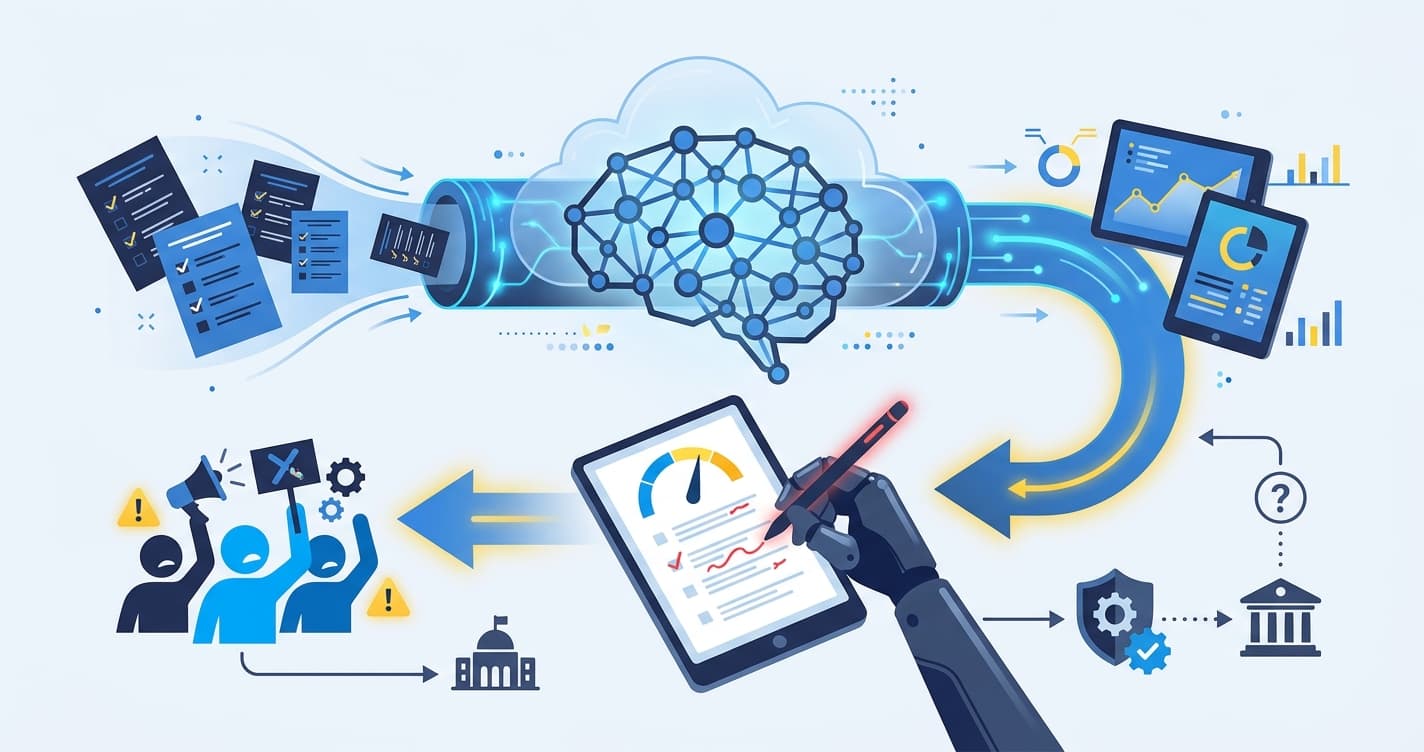
On-Screen Marking is a digital evaluation workflow:
- Students write their board exam answers on physical paper, as before
- Answer sheets are collected and scanned at evaluation centres
- The scanned images are uploaded to a portal
- Trained examiners log in and grade the answers on screen, marking each response on the digital image
- Marks are tabulated automatically; results are released centrally
The key thing to understand: the human examiner is still doing the grading. OSM is not AI grading. The digital layer is the interface, not the marking engine. Quality of marks depends on examiner attention, the fidelity of the scan, and the stability of the portal.
CBSE introduced OSM gradually over several years, with Class 12 board exams becoming a full OSM rollout in 2026.
Why students and parents are protesting in 2026
Several distinct problems have surfaced in May 2026, as documented by major Indian news outlets:
1. Blurry, unreadable scanned answer sheets
Multiple students shared screenshots of their scanned answer sheets where the handwriting was effectively indecipherable. Parents have asked the obvious question: how can an examiner accurately grade what they cannot read?
2. Missing pages
Students reported entire pages missing from the uploaded scans — implying portions of their answers were never seen by the examiner, let alone graded.
3. Answer-sheet mismatch
In one widely-shared case, a Class 12 student requested their Physics answer sheet via the re-evaluation portal and received pages that did not belong to them. This raised serious concerns about how scripts are bound to roll numbers in the OSM workflow.
4. Correct answers marked zero
Students compared their actual working to the official marking scheme and found matches — yet received zero marks. Without an audit trail, there is no way to know whether this was examiner error, OSM logic error, or scan corruption.
5. Unevaluated pages
Page-wise marks did not always sum to the final total. Multiple students reported entire pages that appeared to have no grading marks at all.
6. Re-evaluation portal crashes
The portal where students apply for re-evaluation reportedly went down repeatedly for multiple days during peak demand. Students reported login failures, payment gateway errors, and lost submissions.
7. Bright students with inexplicably low scores
High-performing students who anticipated top marks have publicly reported receiving significantly lower-than-expected scores — driving the broader narrative that the system itself is mis-grading.
The class 12 pass percentage drop
CBSE's overall Class 12 pass percentage moved from 88.39% in 2026 to 85.20% in 2026 — a 3.2 percentage point decline. The board has not formally attributed this to OSM, but the timing has fuelled public concern.
CBSE's official response
CBSE has continued to defend the OSM system, asserting that evaluation procedures have been followed and that the system is transparent. The board did acknowledge technical issues with the re-evaluation portal and:
- Reduced the re-evaluation fee to ₹100 per subject
- Promised that no candidate would lose the opportunity to apply due to portal disruptions
- Said technical teams were working on the portal stability issues
The Union Education Minister, Dharmendra Pradhan, sought a detailed report from CBSE on the technical failures.
What students and parents are demanding
The demands have varied across student groups, but the most common ones include:
- Complete manual re-evaluation of answer sheets
- Independent review of the OSM process
- Grace marks of 15–35 to offset perceived OSM under-marking
- Discontinuation of OSM in its current form
CBSE has not committed to any of these as of late May 2026.
What this means for the broader category
This is the first time digital evaluation has faced this level of public scrutiny in India. The broader takeaway is not "digital evaluation is bad" — it is "the quality of the design matters enormously."
Different digital evaluation categories handle these problems very differently. AI grading platforms — where algorithms do the actual marking, not humans — are distinct from OSM and handle several of these failure modes by design rather than by examiner discretion. We have written a separate post on the distinction for readers who want to understand the difference.
For an example of what a properly-built digital evaluation system looks like in practice, see our case study on a CBSE coaching network where 588 grading decisions were audited and the system handled each of the seven OSM failure modes by design.
FAQ
What does OSM stand for in CBSE context?
OSM stands for On-Screen Marking — a digital evaluation workflow where examiners grade scanned answer sheets through a portal rather than on physical paper.
Is OSM the same as AI grading?
No. OSM uses humans (examiners) to grade scanned answer sheets on a digital interface. AI grading uses algorithms to do the actual marking. They are different categories of tools.
When did CBSE introduce OSM?
CBSE has been rolling out OSM gradually since 2023. The Class 12 board exam full rollout was in 2026, which is when the public controversy emerged.
What is the CBSE Class 12 pass percentage drop in 2026?
From 88.39% in 2026 to 85.20% in 2026 — a 3.2 percentage point decline. Causation has not been formally established but the timing has driven public concern.
Can students request re-evaluation under OSM?
Yes. CBSE has a re-evaluation portal where students can apply, paying ₹100 per subject in 2026 (reduced from the original fee due to controversy). The portal itself has faced technical issues during peak demand.
Related reading
- AI Grading vs CBSE OSM: the difference
- The 7 things that went wrong with CBSE OSM in 2026 — and how AI grading handles each
- Case study: how a CBSE coaching network proved AI grading handles every OSM problem
Related India subjective assessment guides
IntelGrader's India positioning is now centred on written and descriptive assessment. Start with AI subjective assessment software in India, then read AI answer sheet evaluation for boards, UPSC, and universities. For objective exam prep, use JEE and NEET subjective step analysis to see how written practice reveals student thinking before MCQs.
Ready to transform your grading?
See how IntelGrader can save your tutoring centre 10+ hours per week with AI-powered grading.