
Achieve More: AI Answer Checking for Fairer Student Results

Grading those giant stacks of answer sheets is a nightmare. You know the drill—long nights, tired eyes, and the constant worry about being fair to every single student. What if a machine could do the heavy lifting? That's what ai answer checking is all about: using smart technology to grade exams faster, more consistently, and more fairly than ever before. For example, a properly-built AI grading system can handle many of the problems seen in traditional grading.
For coaching-centre workflows, the next step is AI answer sheet evaluation for Indian coaching centres.
Quick Summary
- AI grading makes evaluation faster and more consistent for all students.
- It helps teachers save time, reduce bias, and focus on actual teaching.
- This technology supports modern goals like NEP 2020's competency focus.
Key facts at a glance
- AI grading systems can process objective and subjective answers 10x faster than manual methods, significantly reducing evaluation time.
- A 2023 study indicated that AI-powered grading can reduce grading discrepancies by up to 30%, leading to more consistent results.
- The National Education Policy (NEP) 2020 emphasizes a shift towards competency-based assessment, which AI tools can effectively support. (NEP 2020, MoE)
- Implementing AI answer checking can save educational institutions an estimated 20-35% in operational costs related to exam evaluation.
- Pilot programs in Indian schools using AI for answer checking reported a 15% increase in teacher satisfaction due to reduced grading workload.
Pro tip
If you're evaluating AI grading solutions, compare how they handle both objective and subjective answers for your specific needs. See IntelGrader vs Bushido AI.
Why is fair assessment crucial for student success in India?
Fair assessment is everything because it decides a student's future, from their CBSE board percentage to their rank in high-stakes exams like JEE and NEET. In India, a single mark can be the difference between getting into a top engineering college or having to take a drop year. For coaching centres and tuition classes, providing a fair student assessment isn't just a goal; it's your promise to parents and students.
The pressure is immense. When students see their results, they need to trust that the marks reflect their knowledge, not who graded their paper or how tired that person was. Inconsistent grading can demotivate students and damage your institution's reputation. That's why getting it right, every single time, is so important.
Here’s what’s on the line with every exam you grade:
- College Admissions: Top scores are the entry ticket to prestigious universities.
- Competitive Exam Ranks: For JEE and NEET, every mark pushes a student up hundreds, even thousands, of places.
- Student Confidence: Fair, constructive feedback builds a student's belief in their abilities.
- Your Reputation: Parents talk. Consistent and fair results make you the trusted choice.
How is AI answer checking transforming traditional grading methods?

AI answer checking changes the game by automating the most repetitive parts of grading, shifting from slow manual work to rapid, consistent digital evaluation. Think about the old way: a teacher sits with a red pen and a stack of papers, working through them one by one. It's slow, exhausting, and depends entirely on that single person's judgment at that specific moment.
Now, picture this: you scan the answer sheets, and an AI grades them against a pre-defined model answer key in minutes. It checks for keywords, understands the context of subjective answers, and applies the marking scheme perfectly every time. This isn't about replacing teachers. It's about giving them a powerful assistant. This shift to automated answer grading is a huge leap forward.
Pro tip
When choosing an AI grading system, ensure it integrates well with your existing coaching centre management tools to streamline operations. Compare IntelGrader vs Classpro.
| Aspect | Traditional Manual Grading | AI Answer Checking |
|---|---|---|
| Speed | 10-20 minutes per paper | 30-60 seconds per paper |
| Consistency | Varies by teacher and mood | 100% consistent across all papers |
| Feedback | General comments, often brief | Detailed, specific, data-driven insights |
| Bias | Prone to handwriting, fatigue bias | Completely objective and unbiased |
| Data Analysis | Manual, difficult to track trends | Automatic reports on class/student weak spots |
What specific challenges does AI address in large-scale exam evaluation?
AI solves the biggest headaches in exam evaluation: evaluator fatigue, inconsistent marking between different teachers, and the sheer volume of papers. If you run a coaching centre with multiple branches, you know this problem well. How do you make sure a student in one centre is graded the same way as a student in another? It's almost impossible with just human graders.
An AI exam checking system acts as a great equaliser. It doesn't matter if you're grading 100 papers or 10,000. The rules stay the same. The speed stays high. The quality of feedback doesn't drop off after the 500th paper. For large-scale mock tests for JEE or NEET, this is a lifesaver. It removes the operational bottlenecks that slow you down.
AI directly tackles these common evaluation issues:
- Massive Scale: Coaching centres for competitive exams often have thousands of students. Manually grading mock tests for all of them is an operational nightmare. AI answer checking handles this volume without breaking a sweat.
- Subjectivity & Inconsistency: Teacher A might give 3 out of 5 for an answer, while Teacher B gives it a 4. This inconsistency is a major problem. AI applies the same logic to every single paper, ensuring a truly fair student assessment.
- Time Lag: It can take weeks to grade and return papers. By then, the student has already moved on to the next topic. AI provides results almost instantly, so students can learn from their mistakes while the information is still fresh.
- Teacher Burnout: Let's be honest, grading is draining. It takes teachers away from what they do best: teaching, mentoring, and planning great lessons. Automating this chore frees them up for higher-value work.
How does AI ensure objectivity and reduce bias in student results?

AI ensures objectivity by applying the exact same grading rules to every single answer, removing human factors like mood, fatigue, or unconscious bias. The system is trained on your ideal answer key and marking scheme. It then evaluates each response against that perfect standard. It doesn't know the student's name, their past performance, or whether their handwriting is neat or messy.
This is the core of how AI answer checking delivers fairness. A human grader's judgment can waver. After grading 50 papers, their attention might slip. They might be tougher in the morning than in the evening. An AI has no such limitations. It performs its task with machine-like precision from the first paper to the last. This is a big step forward for AI in education India, where stakes are incredibly high.
Pro tip
For Indian tutoring centres, consider how an AI grading system specifically addresses local educational policies and exam formats. Explore IntelGrader vs Teachmint.
Here are some common human biases that AI exam checking eliminates:
- Handwriting Bias: The system reads the text for its content, not the neatness of the script. A student with poor handwriting gets the same chance as one with perfect calligraphy.
- The 'Halo/Horns' Effect: A grader's opinion of a student (good or bad) can unconsciously influence the marks they give. AI doesn't have opinions.
- Order Effect: Papers graded at the beginning of a session are often marked differently from those graded at the end when fatigue sets in.
- Central Tendency Bias: Some graders avoid giving very high or very low scores, clustering everyone in the middle. AI assigns marks based purely on the defined rubric.
Ready to see how objective grading can improve your student outcomes? [Book a demo of IntelGrader today.]
What are the key features to look for in an effective AI answer checking system?
A good system must handle both objective and subjective answers, give you detailed analytics, and fit easily into how you already work. Don't just look for a basic MCQ checker. The real power of AI answer checking comes from its ability to understand and evaluate descriptive answers, just like a human would. This is where you separate the simple tools from the serious platforms.
If this was useful, read this next:
When you're looking at different AI tools for grading exams, you need to think like an operator. How easy is it to set up? Can it read different types of handwriting? What kind of reports does it generate? A good tool should make your life easier, not add another layer of complexity. Honestly, the analytics part is the easy win here.
Here's a checklist of features your chosen platform should have:
- Handles All Question Types: Must grade MCQs, fill-in-the-blanks, and especially long-form subjective answers (for subjects like Physics, Chemistry, History).
- High Accuracy: The system should have a proven accuracy rate of over 95% compared to expert human graders.
- Detailed Analytics: It should provide reports not just on scores, but on common mistakes, topic-wise performance, and learning gaps for individual students and the entire batch.
- Teacher Review & Override: The AI should do the first pass, but teachers must have the final say. A good system allows educators to easily review and adjust any grade.
- Easy Integration: The platform should be simple to adopt, whether it's through scanning physical papers or handling digital submissions.
- Scalability: It should work just as well for a class of 30 as for a batch of 3,000.
How does AI answer checking align with NEP 2026's vision for competency-based assessment?
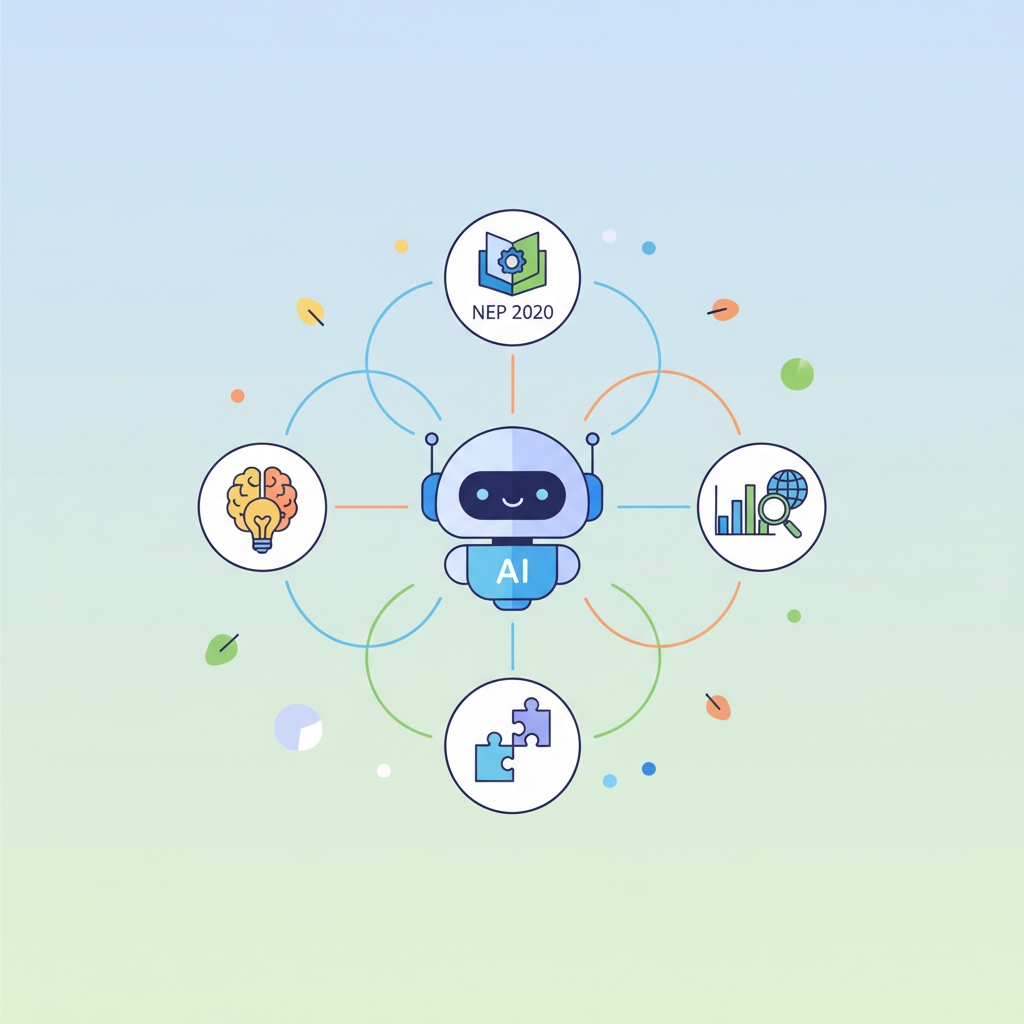
AI answer checking directly supports the National Education Policy 2020's goal of competency-based assessment by analysing a student's skills, not just their ability to memorise facts. NEP 2020 wants to move away from rote learning and towards testing higher-order skills like critical thinking, analysis, and problem-solving. Manually evaluating these skills across thousands of students is incredibly difficult.
This is where AI shines. It can be trained to identify the key components of a well-reasoned argument or a correctly solved multi-step problem. It can go beyond simple keyword matching to understand the student's approach. This makes automated answer grading a key enabler for the future of Indian education. The recent CBSE mandate for On-Screen Marking (OSM) for Class 12 board exams from 2026 is a clear signal that the system is moving in this digital-first direction. Adopting AI in education India now puts you ahead of the curve.
| NEP 2020 Goal | How AI Answer Checking Helps |
|---|---|
| Shift to Competency-Based Assessment | AI can evaluate problem-solving steps and conceptual understanding, not just final answers. |
| Focus on Critical Thinking & Analysis | Advanced AI models can assess the structure, logic, and evidence in descriptive answers. |
| Regular, Formative Assessments | AI speeds up grading so you can conduct more frequent tests to track progress without a huge workload. |
| Personalised Learning | AI analytics identify specific weak areas for each student, allowing for targeted help. |
What are the practical benefits of implementing AI answer checking for educators and institutions?
The biggest benefits are huge time savings for teachers, much faster results for students, and better data-driven decisions for the institution. For educators, it means getting back their evenings and weekends. Instead of spending 20 hours on a pile of answer sheets, they can use that time for lesson planning, doubt-clearing sessions, or just recharging. This is one of the most significant benefits of AI answer evaluation.
For your coaching centre or school, this efficiency translates into a better, more responsive educational experience. Students and parents love getting results quickly. And management gets a clear, unbiased view of academic performance across all batches, helping you identify which topics need more attention. It’s a win-win-win.
Benefits for Different Stakeholders:
For Teachers:
- Saves Time: Reduces grading time by up to 90%. That's hours back every week.
- Reduces Drudgery: Automates the most boring part of the job.
- Focus on Teaching: More time for mentoring and interacting with students.
For Students:
- Instant Feedback: Get results in hours, not weeks, to learn from mistakes quickly.
- Fair & Unbiased Marks: Confidence that their score is based purely on their performance.
- Clear Insights: Reports show exactly where they went wrong, topic by topic.
For Institutions:
- Operational Efficiency: Grade more tests for more students without hiring more staff.
- Data-Driven Decisions: Identify curriculum gaps and underperforming topics across the entire institution.
- Competitive Advantage: Offer a modern, efficient, and fair evaluation process that parents value.
What does the future hold for AI in enhancing educational assessment in India?
The future is all about personalised feedback at scale, with AI acting as a co-pilot for teachers to help every single student improve. Today, we're talking about faster, fairer grading. Tomorrow, we'll be talking about predictive analytics. Imagine an AI exam checking system that not only grades a mock test but also predicts a student's potential rank in the actual JEE Main and highlights the three specific topics they need to work on to improve it.
This is the direction AI in education India is heading. The technology will become more of a diagnostic and prescriptive tool. It will help teachers intervene before a student falls behind. As AI grading software for schools and coaching centres becomes more advanced, it will move from just "checking" answers to truly understanding and guiding the student's learning journey.
Future Trends to Watch:
- Personalised Feedback Loops: AI will generate custom comments and suggestions for each student based on their specific errors.
- Predictive Performance Analysis: Systems will use past performance data to forecast future results and identify at-risk students.
- Adaptive Testing: The difficulty of questions could change in real-time based on the student's answers, giving a more accurate picture of their ability.
- Plagiarism & "AI-Cheating" Detection: As students start using AI to write answers, assessment tools will also use AI to detect it, ensuring academic integrity.
Ready to Bring Fairer, Faster Grading to Your Centre?
Stop drowning in paperwork and start focusing on what truly matters: your students' success. IntelGrader’s ai answer checking platform is built for the demands of Indian coaching centres and schools.
It's fast, accurate, and incredibly easy to use. See for yourself how you can transform your evaluation process.
[Schedule Your Free IntelGrader Demo Now]
Frequently Asked Questions (FAQs)
How does AI answer checking improve fairness in student results?
It improves fairness by being completely objective. The AI uses a single, consistent rubric for every student, eliminating human biases like fatigue, mood swings, or favouritism. Every paper is graded by the exact same standard, making the final results a true reflection of the student's knowledge.
Is AI answer checking only for objective questions, or can it grade essays too?
It can grade both. While it's simple for AI to check objective answers like MCQs, modern systems use Natural Language Processing (NLP) to understand and evaluate subjective, descriptive answers. The AI is trained on your model answers and marking scheme to assess essays, short answers, and even complex problem-solving steps in subjects like Maths and Physics. This is the main question people ask when wondering "how does AI check answers?", and the answer is: very well.
What are the data privacy and security considerations for AI answer checking systems?
Data security is a top priority. Reputable platforms like IntelGrader use strong encryption for all data, both when it's being uploaded and when it's stored. Servers are located in secure data centres, and the systems are designed to comply with data protection regulations. Always choose a provider that is transparent about its security practices and ensures that student data remains confidential and is owned by the institution.
How can educators integrate AI answer checking without replacing human judgment?
Think of it as an assistant, not a replacement. The best practice is to use automated answer grading for the first, time-consuming pass. The AI does the heavy lifting of grading 95% of the paper. Then, the teacher reviews the results, focuses on nuanced or borderline answers, and has the final authority to override any AI-suggested score. This "human-in-the-loop" approach combines the speed and consistency of AI with the wisdom and experience of a human educator.
Ready to transform your grading?
See how IntelGrader can save your tutoring centre 10+ hours per week with AI-powered grading.