
Revolutionize: ai exam grading software Makes Grading Easy

You know that Sunday evening feeling. A mountain of answer sheets from your coaching centre's weekly test sits on your desk. This is the reality for tutors across India, but it doesn't have to be. An ai exam grading software is a tool that reads, understands, and marks exam papers for you, turning weeks of work into a few hours.
Quick Summary
- AI grading cuts down marking time by over 80%.
- It provides consistent, unbiased feedback for every student.
- You get deep analytics to see exactly where students are struggling.
Key facts at a glance
- AI exam grading software can reduce grading time by up to 80%, allowing teachers to reclaim hours for instruction.
- Studies show AI-powered grading tools achieve up to 95% accuracy in objective question evaluation and significantly high consistency in subjective assessments.
- The global AI in education market is projected to reach $25.7 billion by 2030, with assessment tools being a key driver.
- IntelGrader's AI platform processes over 10,000 answer sheets per hour, far surpassing manual grading speeds.
- Implementing AI grading can lead to a 15-20% improvement in grading consistency across different evaluators.
- Schools using ai exam grading software report a 30% increase in timely feedback delivery to students.
Pro tip
Even with AI, ensuring the accuracy of your grading system is crucial for maintaining student trust and educational standards. Guarantee marking accuracy.
What challenges do educators face with traditional exam grading methods?

The biggest challenge is time. Manual grading eats up hundreds of hours that could be spent teaching, planning better lessons, or just having a life outside the tuition centre.
Beyond the clock, there are other serious headaches. It’s nearly impossible to be 100% consistent. The way you grade the first paper is often different from how you grade the fiftieth. Fatigue sets in. Small biases creep in, even when we try our best to be fair. Students notice these small differences, and it can lead to frustrating conversations. Then there's the sheer physical effort of managing huge stacks of paper, especially for large coaching centres preparing students for JEE or NEET.
Here’s a quick rundown of the common pain points:
- Massive Time Sink: Hours and days spent on repetitive marking.
- Inconsistent Scoring: Different standards applied across a batch due to fatigue.
- Delayed Feedback: Students wait weeks for results, losing the chance to learn from mistakes quickly.
- No Real Insights: You get a final score, but no easy way to see that, say, 70% of students struggled with question 5 on thermodynamics.
- Logistical Nightmare: Storing, managing, and returning thousands of physical answer sheets.
How does AI exam grading software actually work to simplify assessment?

It works by turning a physical answer sheet into digital data that a smart algorithm can analyse. Think of it as a three-step process: scan, analyse, and report. It's much simpler than it sounds.
First, you scan the completed answer sheets. You can use any standard scanner. The system digitises the papers, creating a clear image of each one. This is where the magic begins. The AI-powered grading software uses Optical Character Recognition (OCR) and Intelligent Character Recognition (ICR) to read everything on the page, from printed text to student handwriting.
So, how does AI grade exams? After reading the answers, the AI compares them to a pre-defined answer key or rubric that you provide. For objective questions (MCQs, fill-in-the-blanks), it's a simple match. For subjective answers, it uses Natural Language Processing (NLP) to understand the meaning, keywords, and concepts in the student's response. It checks if the key points from your ideal answer are present. The results are then compiled into a detailed report.
The whole process is incredibly fast.
- Scan & Upload: Batch scan all your answer sheets. No need to do them one by one.
- AI Analysis: The ai exam grading software reads the handwriting, identifies answers, and compares them against your marking scheme.
- Review & Finalise: The software flags any ambiguous answers for a quick human review. You have the final say.
- Generate Reports: Instantly get detailed analytics on individual and class performance.
This system of automated exam grading gives you back your time while providing more detailed feedback than you could ever manage by hand.
What specific types of exams can AI exam grading software effectively evaluate?
This software can handle almost any exam format you throw at it, from fully objective papers to complex subjective ones. It’s built to support the diverse question types found in the Indian education system, whether for CBSE boards or competitive entrance exams, including for answer sheet evaluation.
For coaching centres preparing students for exams like JEE and NEET, which are heavily based on Multiple Choice Questions (MCQs), the benefits are immediate. The ai exam grading software can process thousands of OMR sheets or MCQ answer papers with near-perfect accuracy in minutes. But it doesn't stop there. The technology for AI grading handwritten answers has improved massively. For more details on how Indian Coaching Centres are leveraging this technology, you can refer to our blog.
Here’s a look at what it handles best:
| Exam Type | AI Capability & Use Case | Best For |
|---|---|---|
| Objective (MCQs) | 99%+ accuracy. Instantly grades thousands of papers. | JEE, NEET, CETs, Olympiads |
| Short Answer | Checks for specific keywords and concepts. Great for definitions. | CBSE/ICSE Class 10/12, School exams |
| Long Answer / Essay | Analyses structure, keyword density, and conceptual accuracy. | Board exam prep, UPSC Mains prep |
| Diagrams & Graphs | Can identify and grade labelled diagrams and plotted graphs. | Biology, Physics, Economics |
| Numerical Problems | Verifies steps and final answers in subjects like Maths & Physics. | All science and commerce streams |
This flexibility makes an AI software for checking answer sheets a powerful tool for any educational institution, from a small tuition centre to a large-scale coaching network.
How does AI exam grading software benefit teachers, students, and institutions?
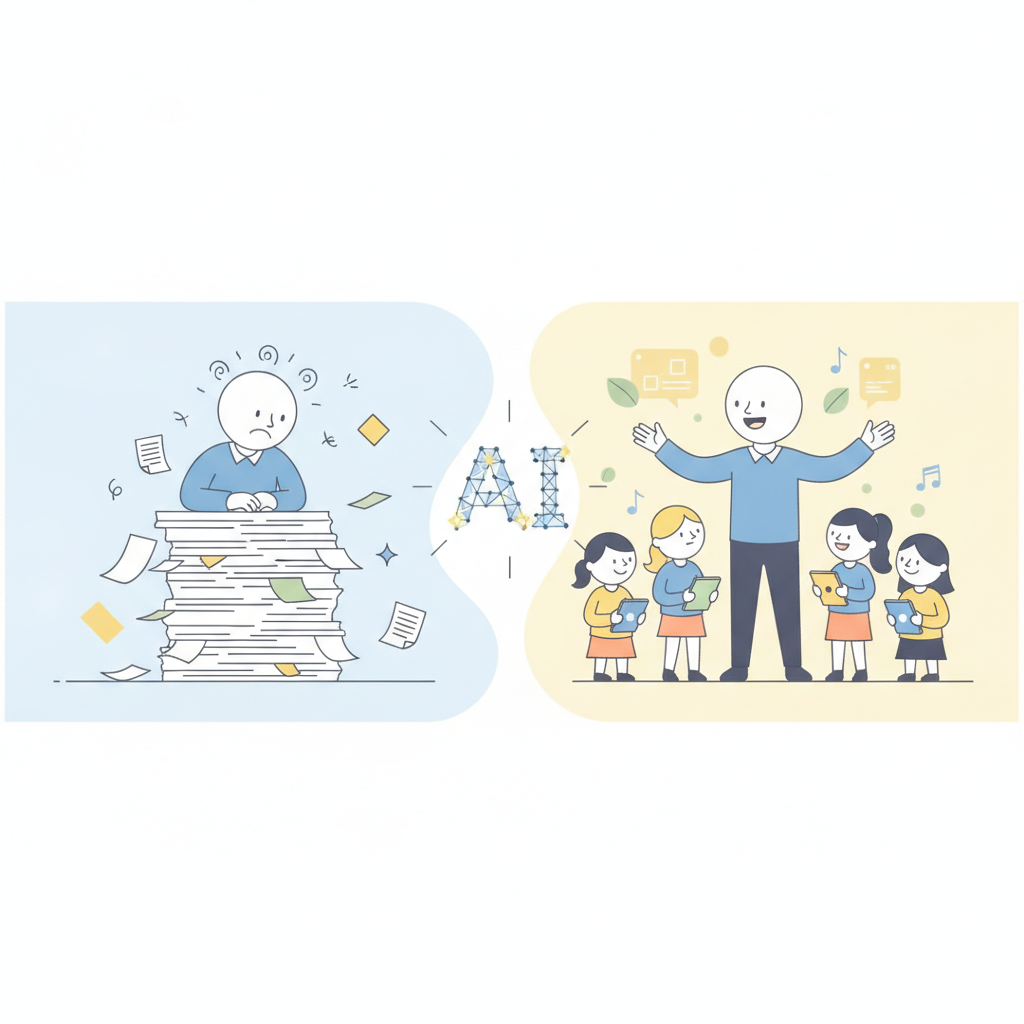
The benefits go far beyond just saving time; it creates a better learning cycle for everyone involved. Teachers are less burned out, students get better feedback, and the institution runs more efficiently.
For Teachers and Tutors
This is the most obvious win. AI grading tools for teachers are designed to eliminate the most tedious part of the job. Instead of spending 20 hours marking a batch of 100 papers, you can get it done in under an hour. This frees you up to focus on what actually matters: teaching. You can prepare better lessons, give one-on-one attention to struggling students, and analyse the performance data the AI provides.
- Reclaim Your Weekends: Drastically cut down on grading time.
- Focus on High-Value Tasks: More time for lesson planning and student interaction.
- Data-Driven Insights: Instantly see which topics the whole class found difficult.
- Eliminate Repetitive Work: Let the machine handle the boring stuff.
For Students
Students get faster, more consistent, and more detailed feedback. They don't have to wait two weeks to find out how they did on a test. They can get their marked papers back in a day or two, while the material is still fresh in their minds. The feedback is also fairer. Every paper is graded against the exact same rubric, removing any chance of human bias or fatigue affecting their score.
- Quick Feedback: Get results in days, not weeks.
- Fair and Unbiased Marking: Every paper is judged by the same standard.
- Clearer Insights: Reports can show them exactly where they went wrong.
- Increased Motivation: Fast feedback loops encourage continuous improvement.
For Coaching Centres and Institutions
For the institution, AI-powered grading software introduces efficiency and a higher standard of quality. It allows you to conduct more frequent tests without overwhelming your faculty. This means more practice for students and more data for you. It also gives you a clear, objective view of performance across all batches and subjects, helping you make better strategic decisions. This is the edge you need.
- Scalability: Easily handle a growing number of students without hiring more graders.
- Standardised Quality: Ensure consistent grading across all your branches and teachers.
- Actionable Analytics: Track performance trends over time to improve teaching methods.
- Digital Records: A secure, searchable archive of all answer sheets.
Ready to see how much time you could save? Book a free demo of IntelGrader today!
What key features should you look for in a top-tier AI exam grading software?
Not all AI grading platforms are created equal. When you're looking for the best AI exam grading software India has to offer, you need to look past the basic sales pitch and check for features that solve real-world problems for Indian educators.
If this was useful, read this next:
The core function is grading, but a good platform does much more. It should be a complete assessment solution. Honestly, if it can't handle handwritten answers well, it's not worth your time in the Indian context. Our exams are still largely pen-and-paper.
Here’s a checklist of what to look for:
- High-Accuracy Handwriting Recognition: It must be able to read varied student handwriting clearly. This is a non-negotiable feature.
- Support for Mixed Question Types: The tool should handle MCQs, short answers, long answers, and even diagrams on the same page.
- Customisable Rubrics: You need full control to set your own marking schemes and keywords for subjective questions.
- Insightful Analytics Dashboard: It should provide more than just scores. Look for question-level analysis, topic-wise performance, and student progress tracking.
- Human-in-the-Loop Review: The AI should flag uncertain or ambiguous answers for a teacher to quickly review. You should always have the final say.
- Scalability and Speed: The platform must be able to process thousands of answer sheets quickly without slowing down.
- Secure and Centralised Storage: All scanned answer sheets and results should be stored securely in one place for easy access.
These features separate a basic tool from a genuine AI-powered grading software that can truly support your institution.
Are there any limitations or ethical considerations when using AI for grading?
Yes, and it's important to be upfront about them. AI for assessment is an incredibly powerful tool, but it's not a magic wand. It's a co-pilot for the teacher, not a replacement.
The main limitation is in understanding true creativity or highly original arguments in subjective answers. While AI is great at checking for facts, keywords, and structure, it can miss the spark of a truly unique insight. That's why the "human-in-the-loop" feature is so important. The AI does the heavy lifting—the first 90% of the work—and then the teacher steps in to review the edge cases and add that final human touch.
Ethical considerations mostly revolve around fairness and bias.
- Data Privacy: Where are student answer sheets stored? Ensure the provider has strong data security policies.
- Algorithmic Bias: The AI is only as good as the data it's trained on. It's important that the system is trained on a diverse set of handwriting and answer styles to be fair to all students.
- Over-reliance: Teachers should use the AI's output as a strong suggestion, not an absolute verdict. The final responsibility for a student's grade should always lie with the educator.
The goal of an ai exam grading software isn't to remove the teacher from the process. It's to remove the drudgery from the process.
How can you integrate AI exam grading software into your existing educational workflow?
Getting started is surprisingly straightforward. You don't need to change your existing exam process. Students can continue taking tests with pen and paper just as they always have. The change happens after the exam is over.
Integrating automated exam grading is a simple, step-by-step process.
- Conduct Exams as Usual: No changes needed here. Students write their exams on standard paper.
- Scan the Answer Sheets: After collecting the papers, use a standard office scanner to digitise them in batches. This is the only new manual step.
- Upload to the Platform: Drag and drop the scanned files into the IntelGrader platform.
- Define Your Answer Key: For the first time you run a test, you'll create a digital marking scheme. Tell the AI what the correct answers are and what keywords to look for in subjective questions. This key can be saved and reused for future tests.
- Let the AI Do the Work: The AI will grade the entire batch in minutes or hours, depending on the volume.
- Review and Publish: Do a quick spot-check, especially on answers the AI has flagged. Once you're happy, publish the results for students to see.
The best AI grading tools for teachers are designed to fit into your world, not the other way around.
What does the future of assessment look like with AI exam grading software?
The future of assessment is faster, smarter, and more focused on student growth. With tools like ai exam grading software, we're moving away from just giving a final score and towards providing continuous, formative feedback.
This shift aligns perfectly with the goals of India's NEP 2026, which calls for a move towards competency-based assessment. The policy wants to reduce the pressure of high-stakes board exams and focus more on testing real understanding and skills. AI for assessment helps make this possible by allowing coaching centres and schools to conduct more frequent, low-stakes tests. The detailed analytics from these tests can show exactly which competencies a student has mastered and where they need more help.
Furthermore, with CBSE mandating On-Screen Marking (OSM) for Class 12 answer sheets from 2026, the entire country is moving towards digital evaluation. Adopting an AI-powered grading software now puts your institution ahead of the curve. You'll be ready for this digital shift long before it becomes compulsory. The future isn't about replacing teachers; it's about giving them better tools to do their most important work.
Ready to leave manual grading behind?
Stop spending your nights and weekends buried in paperwork. See how IntelGrader's ai exam grading software can give you back your time, provide fairer grades, and deliver insights that help your students succeed.
Schedule Your Personalised Demo Now
Frequently Asked Questions
What is AI exam grading software?
An ai exam grading software is a tool that uses artificial intelligence to automatically evaluate student answer sheets. It scans physical papers, uses technology to read handwriting and typed text, and grades answers against a pre-set marking scheme, for both objective and subjective questions.
Can AI exam grading software grade handwritten answers?
Yes, absolutely. Modern AI grading handwritten answers is highly effective. Using advanced Intelligent Character Recognition (ICR), these systems can accurately read and interpret a wide variety of handwriting styles, making them perfect for the typical pen-and-paper exams common in India.
How accurate is AI exam grading compared to manual grading?
For objective questions like MCQs, AI accuracy is over 99%, far exceeding human accuracy, which can be affected by fatigue. For subjective answers, AI provides unmatched consistency. While a human teacher's grading can vary from the first paper to the last, an AI grades every single paper against the exact same rubric, ensuring fairness. The accuracy is high, and any ambiguous answers are flagged for a final check by the teacher.
What are the benefits of using AI for exam grading?
The main benefits are a massive reduction in time spent grading (up to 80%), completely consistent and unbiased scoring, and instant access to detailed performance analytics for every student and the entire class. This allows teachers to provide faster feedback and focus on teaching, not just marking. These are the key advantages of AI grading tools for teachers.
Ready to transform your grading?
See how IntelGrader can save your tutoring centre 10+ hours per week with AI-powered grading.