
Batch Learning Gaps with AI Grading
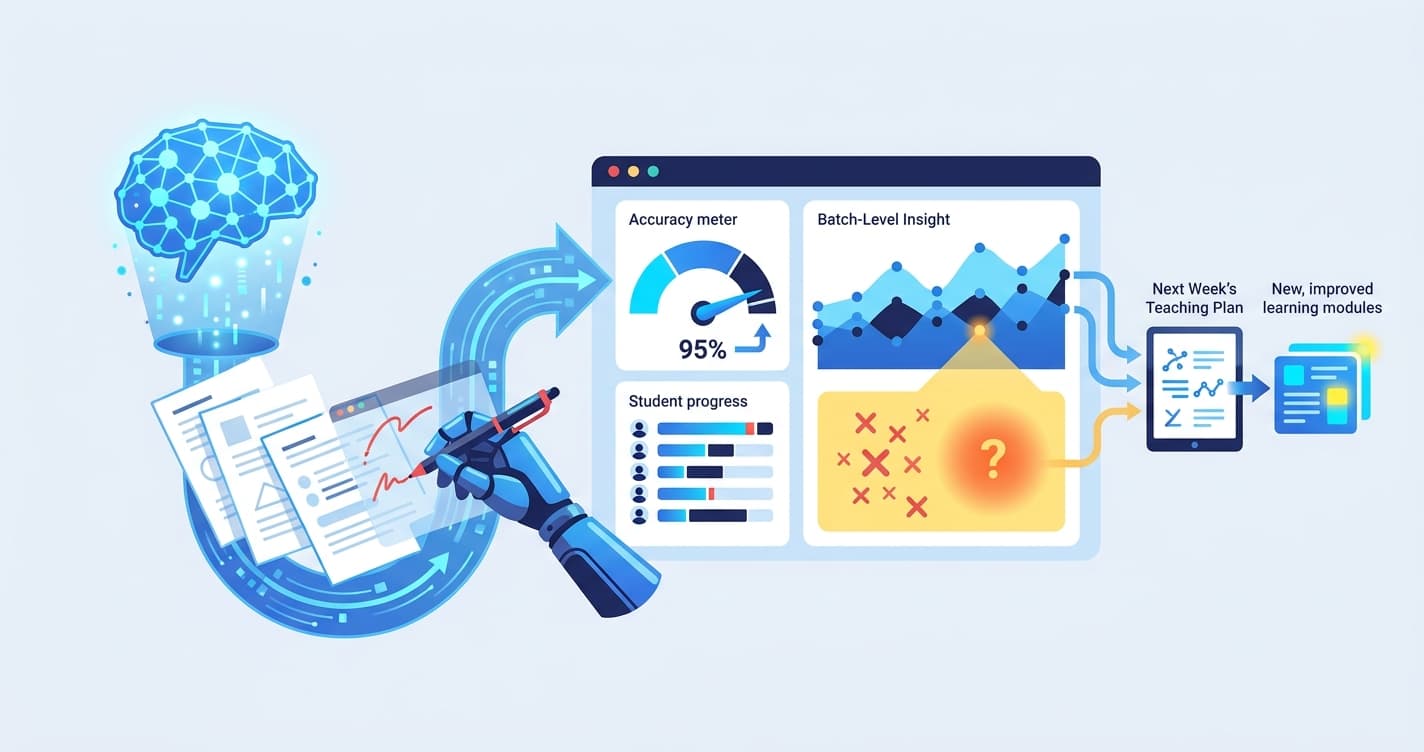
Because teams search for batch learning gaps, this guide keeps the workflow practical. It explains where AI helps, what teachers should review, and how to turn scoring into better student feedback.
Identifying Learning Gaps Across a Whole Batch with AI Grading
The batch-level view
A tutor with 30 students can read 30 individual reports — slowly, painfully — and try to remember the patterns. Or the AI can surface the patterns directly: "22 students missed Q4. The misconception: confused exothermic with endothermic when the temperature gradient was reversed."
That single observation reshapes next session more than 30 individual feedback comments could.
What batch-level analytics surface that individuals can't
Five categories:
- Concept blind spots — a concept the whole batch is shaky on (usually a teaching gap, not a student gap)
- Misconception clusters — the same wrong answer appearing 15 times means the wrong mental model is widespread
- Difficulty calibration — the test was too easy or too hard; what to adjust
- Engagement signals — were students rushed (errors clustered at the end)? Distracted (errors random)?
- Prerequisite weaknesses — multiple students missing a foundational concept that should have been mastered earlier
These are observable only when the whole batch's data is analysed together.
The diagnostic question
After every batch test, the AI should answer: "If I had 20 minutes with the whole batch tomorrow, what would maximally help them?"
That's the batch-level recommendation. It's almost never "review last week" generally; it's usually "re-teach this specific concept that 60% of you missed".
What good batch analytics output looks like
A one-page report:
- Top 3 concepts missed across the batch — with student counts
- The single biggest misconception — phrased as the wrong model students seem to hold
- Recommended re-teach focus — specific topic, specific duration
- Calibration note — was this test the right difficulty?
- Cohort vs. previous batches — how does this batch compare?
A page the tutor can read in 60 seconds and act on in the next session.
A real-world example
A coaching centre in Pune, JEE Physics batch (data from 2025):
- Test result on first attempt at Rotational Dynamics: average 4/10; 78% missed Q3 (angular momentum conservation)
- Batch-level diagnosis: students were treating angular momentum as analogous to linear momentum without accounting for moment of inertia
- Tutor action: 25-minute targeted re-teach using a hands-on demonstration
- Retest two weeks later: average 7/10; 28% missed the analogous question
A 50-point batch improvement, driven by a single batch-level insight the AI surfaced.
Where batch analytics fall short
Three limitations to know about:
- Small batches (< 10 students) — patterns get noisy; trust individual diagnostics more
- Highly differentiated batches — when student ability varies wildly, the "batch pattern" is mostly noise
- Highly creative/open-ended subjects — patterns are harder to detect when there's no single correct answer
For most STEM and exam-focused batches of 15+ students, batch-level analytics deliver outsized value.
The teaching cadence
A week with batch analytics in the loop:
- Saturday: batch test
- Sunday: AI grades + generates batch-level diagnosis
- Monday morning: tutor reviews diagnosis (~5 min)
- Monday class: targeted 20-min re-teach
- Tuesday-Friday: normal teaching continues; reinforcement woven in
- Saturday: retest; pattern check
Over a term, persistent batch-level weak topics shrink steadily; new gaps surface as new topics are introduced; the teaching responds to actual student data rather than the syllabus alone.
Common pitfalls
- Reading too much into one batch test — wait for 2–3 data points before changing teaching
- Over-correcting on noise — if 4 out of 30 missed something, that's not a batch pattern, that's individual
- Ignoring the calibration note — if the test was too hard, the "weak concepts" might just be "hard questions"
What this changes about teaching
The biggest mindset shift: teaching becomes responsive rather than scheduled. The syllabus still exists, but the next lesson's emphasis flexes based on what the data actually shows. Tutors stop teaching the topic and start teaching the students — at scale.
This is the operating model of a modern AI-supported tutoring centre.
Book a demo to see how batch-level analytics look on your students' data.
FAQ
What's a batch-level learning gap?
A concept the whole class missed (or got wrong with the same misconception). It's usually a teaching gap, not a student gap — the tutor didn't cover the concept deeply enough, or covered it but in a way students didn't retain.
How big a batch is needed for batch-level analytics?
At least 15 students. Below 10, individual variation drowns the signal. Above 30, patterns become statistically clear; above 50, granular sub-pattern detection becomes possible.
How is this different from a per-student report?
A per-student report tells you Maya needs to work on fractions. A batch-level report tells you 18 of 30 students confused fractions and decimals on the same question — meaning the teaching needs to be revised, not just student remediation.
What should I do with a batch-level gap insight?
Re-teach the specific concept in the next session, with a different approach (visuals, manipulatives, a different worked example). Then retest in 1–2 weeks to confirm the gap closed.
How quickly do batch-level gaps close after targeted re-teaching?
Typically within 1–2 weeks. Persistent gaps may need a different teaching approach (not just more repetition). If the gap doesn't close after 3 re-teach attempts, the underlying prerequisite is probably missing.
Related IntelGrader Resources
Ready to transform your grading?
See how IntelGrader can save your tutoring centre 10+ hours per week with AI-powered grading.