
AI Diagnostic Assessment Guide
Diagnostic Assessment with AI: Identifying Weak Concepts in 5 Minutes
What is a diagnostic assessment?
A diagnostic assessment is a short, targeted test designed to reveal what a student already knows and doesn't know — before regular teaching starts. Unlike a regular test, it isn't graded for a report card. It's a map of strengths and gaps.
Traditional diagnostic assessments take 60+ minutes of testing and 90+ minutes of tutor marking. AI-driven diagnostics cut both ends: shorter, more focused tests; instant analytics.
Why it matters
Most tutors meet a new student and ask: "Where are you struggling?" The student says: "Maths." The tutor says: "Okay, let's start with Chapter 5." Three sessions in, the tutor discovers the student is solid on Ch 5 but lost on the prerequisite from Ch 3.
A diagnostic assessment surfaces that prerequisite gap in the first session. The next 12 sessions are then targeted, not exploratory.
What an AI diagnostic actually does
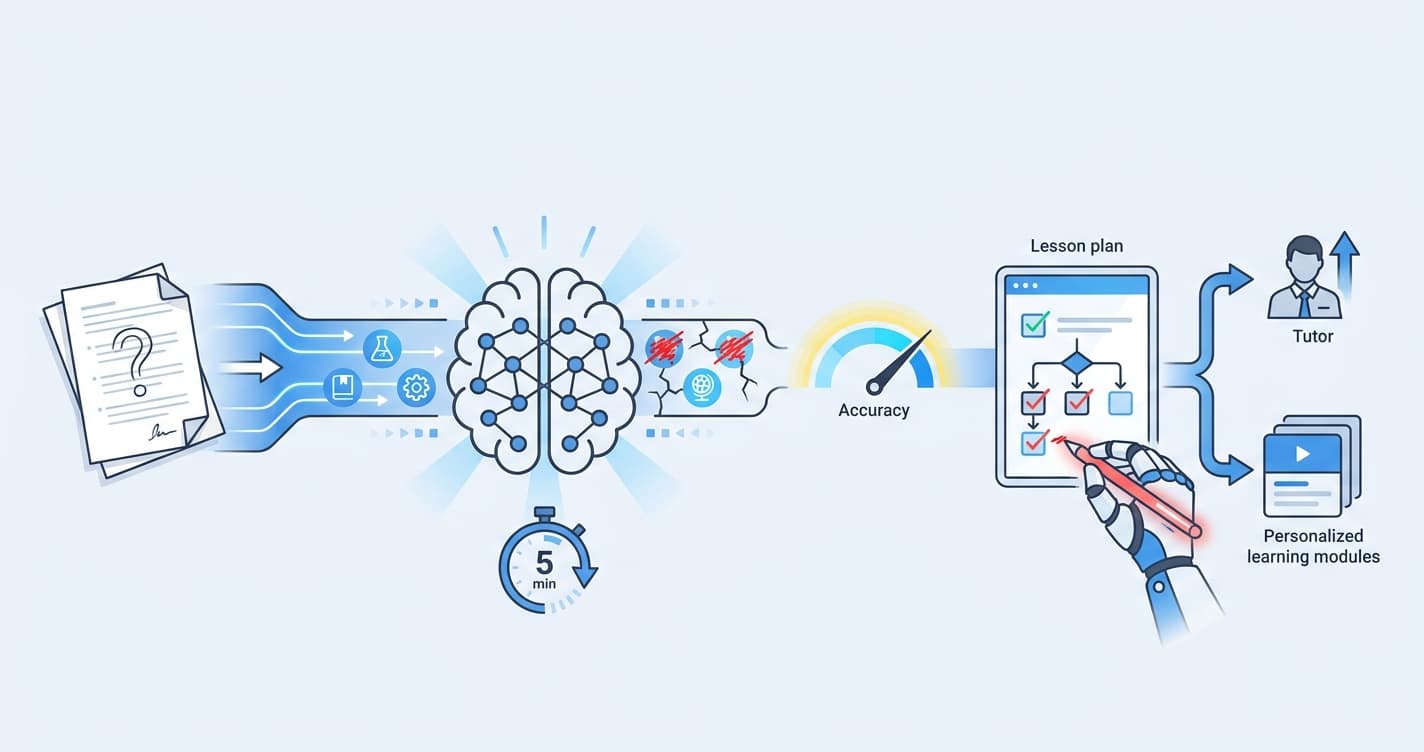
The assessment runs as a short test — typically 15–20 questions covering a concept map. The AI then:
- Marks the responses (handwritten or typed)
- Maps each correct/incorrect answer to a concept node
- Builds a personalised gap profile: which concepts solid, which shaky, which missing
- Recommends a starting point — and a 4-week plan
The whole process takes 5 minutes per student to administer, 30 seconds to process.
A practical example
A student joins a JEE Physics batch in April. The diagnostic test takes 20 minutes. The AI's report:
- Strong on: Kinematics, Newton's Laws, Energy
- Shaky on: Rotational mechanics (specifically: angular momentum conservation)
- Missing: Electromagnetism prerequisites (Coulomb's law not internalised)
Tutor's planned sequence: 1 week of EM foundations, 1 week of rotational mechanics reinforcement, then normal batch sequence. Without the diagnostic, the tutor would have started in the standard sequence and discovered the gaps 3 weeks later.
What a diagnostic doesn't replace
- The tutor's read on motivation — diagnostics measure knowledge, not engagement
- Soft factors — exam anxiety, peer comparison, family pressure
- Cumulative judgment — diagnostics are a snapshot, not a relationship
The diagnostic accelerates the start. The relationship sustains the progress.
How often to re-diagnose
A diagnostic isn't a one-time event. Useful cadence:
- At start of any new tutor-student relationship — sets the baseline
- At start of a new module or topic block — checks prerequisite readiness
- At mid-point of a long course — verifies trajectory
- Before a high-stakes exam — final calibration
Some platforms (IntelGrader included) re-diagnose continuously from regular test data — no separate diagnostic event needed.
What to look for in an AI diagnostic tool
- Concept-mapping depth — does it map errors to sub-concepts or just chapter headings?
- Adaptive question selection — does it ask harder/easier questions based on responses?
- Time efficiency — can a student complete it in 15 minutes?
- Output usability — can the tutor act on the report in 5 minutes?
- Re-diagnostic ability — does the platform update the map as new test data comes in?
Common pitfalls
Three mistakes centres make with diagnostics:
- Treating the diagnostic as the answer, not the input — the diagnostic informs the plan, it doesn't replace the plan
- Sharing the diagnostic with parents — never. Parents will misread "weak on Q12" as "my child is failing"
- Ignoring the diagnostic after week 2 — the gap map is dynamic; teaching should respond to it weekly
The cumulative effect
Centres that run regular diagnostic-informed planning typically see:
- 30–50% reduction in time spent re-teaching prerequisites
- Higher early-confidence among new students (they feel "seen" by the targeted plan)
- Earlier identification of students at risk
The headline number is teaching efficiency. The hidden number is student retention.
Book a demo to run a diagnostic on your incoming batch.
FAQ
What's the difference between a regular test and a diagnostic?
A regular test grades performance. A diagnostic maps what the student already knows and doesn't know — it's the input to teaching, not the output. Diagnostics aren't reported to parents as scores.
How long does an AI diagnostic take?
A student typically completes a diagnostic in 15–20 minutes. The AI processes it in under 30 seconds. The tutor reads the report in 5 minutes. Total: ~30 minutes per student vs. weeks of trial-and-error otherwise.
When should I run a diagnostic?
At the start of any new tutor-student relationship, at the start of a new module, at mid-point of a long course, and before a high-stakes exam. Some platforms diagnose continuously from regular test data — no separate event needed.
Can the diagnostic be wrong?
A diagnostic is a snapshot. Students have good days and bad. A useful platform shows confidence bands ("mastery 70%, confidence medium") not single numbers, so tutors know how much to trust each datapoint.
Should parents see the diagnostic report?
No. Parents misread "weak on Q12" as "my child is failing". The diagnostic is for the tutor's planning, not for parent communication. Share progress reports, not diagnostic gap maps.
Related IntelGrader Resources
Ready to transform your grading?
See how IntelGrader can save your tutoring centre 10+ hours per week with AI-powered grading.