
Crowdmark Alternative for Educators
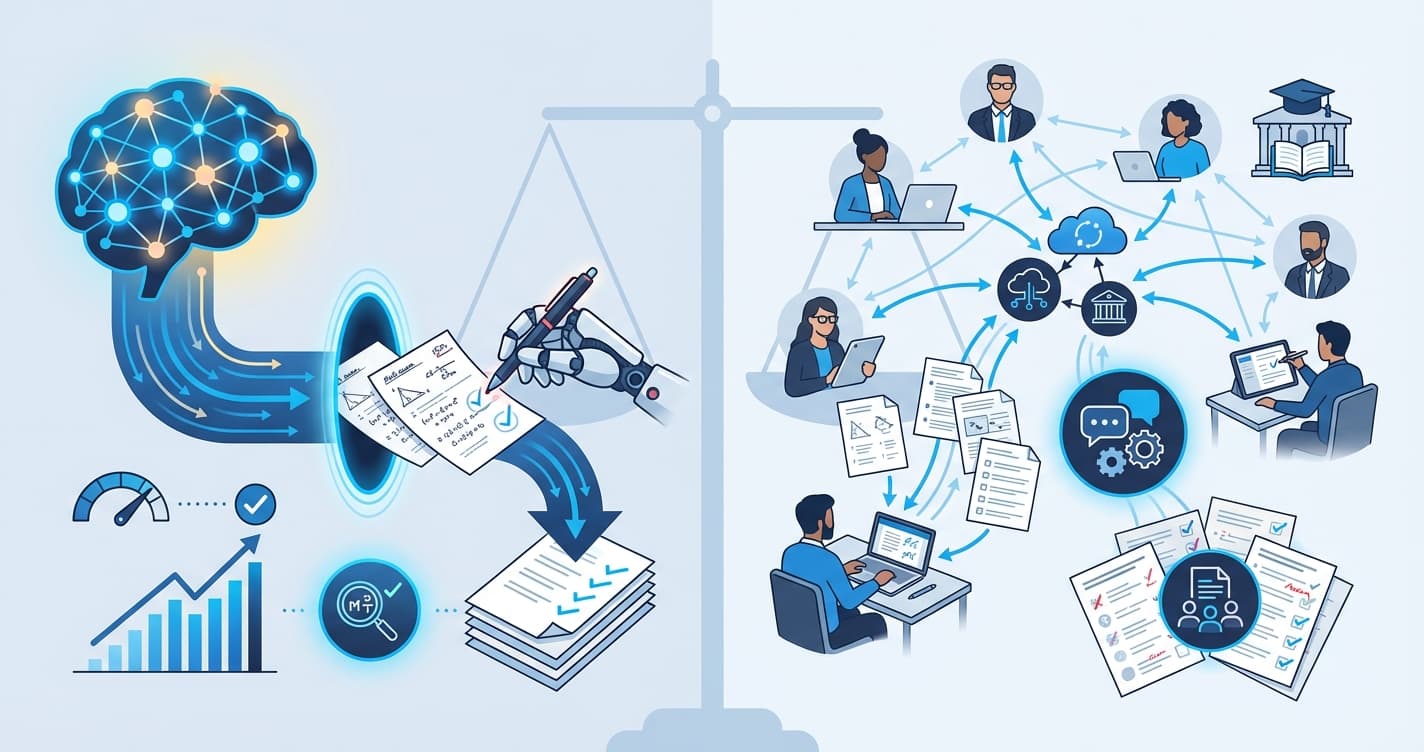
Compare IntelGrader and Crowdmark. Crowdmark enables distributed grading for universities — IntelGrader automates handwritten math grading for tutoring centres.
Overview
If you have come across Crowdmark while searching for grading tools, you are likely exploring options that make assessment faster and more efficient. Crowdmark is a well-regarded online collaborative grading platform built in Canada, designed to streamline how universities handle large-scale exams and assignments. It takes a distinctive approach: digitising paper-based assessments and distributing individual pages to different graders, so multiple instructors and teaching assistants can grade simultaneously without being in the same room or working on the same paper at the same time.
IntelGrader approaches the grading problem from a different angle entirely. Rather than distributing human grading work more efficiently, IntelGrader uses AI to eliminate the manual grading step altogether — at least for handwritten math. Built for tutoring centres, coaching centres, and K-12 educators, IntelGrader's OCR engine reads student handwriting, grades math submissions automatically, delivers instant personalised feedback, and tracks student progress with analytics designed for parent communication and business reporting.
Both platforms aim to reduce the time educators spend grading. Crowdmark achieves this by making human grading workflows faster and more collaborative. IntelGrader achieves this by automating the grading itself. The right choice depends on whether you need a better way to organise human graders or a way to remove the human grading bottleneck entirely.
Feature Comparison
| Feature | IntelGrader | Crowdmark |
|---|---|---|
| Grading approach | Fully automated AI grading for handwritten math | Distributed collaborative grading by human instructors and TAs |
| Handwriting recognition | Purpose-built OCR trained on real student handwriting for math | Digitises handwritten pages for human review; no automated handwriting grading |
| Subjects supported | Mathematics (arithmetic through advanced algebra, calculus) | Any subject — grading is done by humans, so subject scope is unlimited |
| Target audience | Tutoring centres, coaching centres, K-12 math educators | Universities and colleges with multi-grader assessment needs |
| Pricing model | Affordable per-centre pricing, no institutional license required | Institutional pricing; free tier available for individual instructors with limited features |
| Grading speed | Instant — results returned in seconds after submission | Faster than traditional grading through parallelisation, but still requires human time |
| Feedback delivery | Automated personalised feedback generated by AI | Instructor-written feedback delivered digitally to students |
| Progress analytics | Built-in student progress tracking, trend analysis, parent-ready reports | Assignment-level analytics and grade distribution insights |
| Multi-grader support | Single-user workflow (one educator or centre) | Core feature — designed for teams of graders working on the same assessment |
| Mobile workflow | Yes, scan-and-grade from any device | Web-based; students can submit photos of handwritten work |
Where Crowdmark Wins
Crowdmark has carved out a strong niche in higher education for good reasons, and it genuinely excels in several areas that matter for university-level assessment.
Distributed grading for large teams. Crowdmark's signature feature is its ability to break a single assessment into pages and distribute those pages across multiple graders. If you have a 200-student final exam with 8 questions and 4 teaching assistants, Crowdmark lets each TA grade specific questions across all 200 papers simultaneously. This parallelisation dramatically reduces the time between collecting exams and returning grades. For universities that rely on teams of TAs, this workflow is genuinely transformative.
Subject-agnostic grading. Because Crowdmark facilitates human grading rather than automated grading, it works for any subject. English essays, chemistry problems, engineering diagrams, philosophy arguments — if a human can grade it, Crowdmark can organise the workflow around it. There are no subject limitations because the intelligence comes from the grader, not the software.
Assessment design flexibility. Crowdmark supports a wide range of assessment formats including traditional exams, take-home assignments, and even group projects. Instructors can create assessments directly in the platform, and students can submit handwritten work by photographing it. The platform handles the logistics of collecting, organising, and distributing that work to the right graders.
Canadian data residency. For Canadian institutions with data sovereignty requirements, Crowdmark's Canadian headquarters and data storage can be a meaningful advantage. Data residency regulations are increasingly important in education, and Crowdmark's Canadian infrastructure addresses this concern directly.
Where IntelGrader Wins
IntelGrader was designed for a fundamentally different workflow — one where the goal is not to distribute grading work among humans but to automate it entirely.
Automated grading, not assisted grading. This is the core distinction. Crowdmark makes it easier for humans to grade. IntelGrader makes grading happen without human intervention. When a tutoring centre uploads a batch of handwritten math worksheets to IntelGrader, the AI reads each student's handwriting, evaluates each answer, assigns scores, and generates personalised feedback — all automatically. There is no human grader in the loop. For a tutoring centre owner who is also the only grader, this difference is not incremental — it is the difference between spending two hours every evening grading and spending zero.
Purpose-built for tutoring and coaching centres. Crowdmark's workflow assumes you have multiple graders who need to collaborate on assessment. Most tutoring centres do not operate this way. A typical tutoring centre has one owner or a small team of tutors who need to grade stacks of worksheets quickly between sessions. IntelGrader's workflow matches this reality: scan the worksheets, upload them, and get graded results back instantly. No grading team required.
Instant feedback that drives learning. When IntelGrader grades a submission, it generates personalised feedback explaining what the student got wrong and how to approach the problem correctly. This feedback is available immediately — not after a team of TAs finishes grading over the weekend. In a tutoring context, where sessions happen daily or several times a week, this immediacy transforms the learning loop. Students can review their mistakes before the next session, and tutors can adjust their teaching based on real-time data.
Progress tracking and parent reporting. Tutoring centres need to demonstrate value to parents, and IntelGrader's analytics are designed for exactly this purpose. Progress over time, topic-by-topic performance, improvement trends — these reports are generated automatically and are ready to share with parents. Crowdmark's analytics are focused on class-level grade distributions and assignment performance, which serve university instructors well but do not address the parent communication needs of a tutoring business.
No institutional overhead. Crowdmark, like most higher education tools, requires institutional adoption or at minimum an instructor account within an institutional context. IntelGrader requires none of that. There is no institutional license, no IT department involvement, and no multi-step procurement process. A tutoring centre owner can sign up and start grading the same day.
Affordable for small operations. Crowdmark's pricing is structured for universities and departments. Even its free tier is designed as a gateway to institutional adoption. IntelGrader's pricing is designed from the ground up for tutoring centres and small education businesses — operations where every dollar matters and where the value of a grading tool is measured in hours saved per week, not TAs managed per semester.
Who Should Choose Crowdmark
Crowdmark is the right choice if you are:
A university instructor with teaching assistants who need to grade large exams collaboratively. Crowdmark's page-by-page distributed grading workflow is specifically designed for this scenario and does it better than almost any other platform.
A department head looking to standardise grading practices across multiple sections of the same course. Crowdmark's shared rubrics and distributed grading ensure consistency even when different TAs grade different questions.
An educator grading across multiple subjects. If you need to grade essays, lab reports, and problem sets — not just math — Crowdmark's subject-agnostic approach means you can use one platform for everything, since humans do the actual grading.
A Canadian institution with data residency requirements. Crowdmark's Canadian infrastructure may satisfy compliance needs that platforms hosted elsewhere cannot.
Who Should Choose IntelGrader
IntelGrader is the right choice if you are:
A tutoring centre or coaching centre owner who grades handwritten math worksheets daily and does not have a team of TAs to distribute the work to. IntelGrader replaces the manual grading step entirely rather than just reorganising it.
A math tutor working independently who needs to grade efficiently without collaborators. Crowdmark's strength is multi-grader collaboration — if you are the only grader, that strength is irrelevant to you. IntelGrader's strength is automation, which benefits every educator regardless of team size.
A coaching institute running high-volume math test preparation where speed of feedback directly affects student outcomes. IntelGrader returns graded results in seconds, not hours or days.
A K-12 math educator who needs to grade younger students' handwritten work. IntelGrader's OCR is specifically trained on the kind of handwriting that K-12 students produce — inconsistent, messy, and often hard to read — not the comparatively neat work of university students.
An education business owner who needs to demonstrate student progress to parents. IntelGrader's analytics produce the parent-ready reports that tutoring businesses depend on. Crowdmark does not offer parent-facing features because its university audience does not need them.
The Verdict
Crowdmark and IntelGrader solve the grading problem in fundamentally different ways. Crowdmark makes human grading faster by distributing the workload across multiple graders working in parallel. IntelGrader makes grading faster by removing the human grading step altogether for handwritten math.
If you are at a university with a team of teaching assistants and need to grade multi-subject exams collaboratively, Crowdmark's distributed grading workflow is excellent and well-proven. It is a genuinely useful tool for the specific problem of coordinating multiple graders on large assessments.
If you run a tutoring centre, coaching centre, or K-12 education business and your main grading challenge is handwritten math worksheets, IntelGrader offers something Crowdmark cannot: fully automated grading with instant feedback and progress tracking. You do not need to hire graders or coordinate a team. You need a tool that reads your students' handwriting and grades it accurately, and IntelGrader does exactly that.
Ready to stop grading manually? Book a free demo and see how IntelGrader handles your handwritten math worksheets — no grading team required.
FAQ
Is IntelGrader a Crowdmark alternative?
They serve different markets and solve different problems, so "alternative" depends on your context. If you are a university instructor looking for a Crowdmark alternative for distributed grading, platforms like Gradescope or even simple rubric-sharing tools may be closer comparisons. If you are a tutoring centre or K-12 educator who looked at Crowdmark and found it was not designed for your workflow, IntelGrader is likely what you actually need. IntelGrader automates grading for handwritten math rather than distributing it among human graders, which is a fundamentally different approach that suits smaller operations without grading teams.
Can Crowdmark automatically grade handwritten math?
No. Crowdmark digitises handwritten student work so that human graders can review and mark it on screen rather than on paper. The platform makes the logistics of distributing that work across multiple graders very efficient, but the actual grading is still done by people. IntelGrader, by contrast, uses AI and OCR to read handwritten math and grade it automatically without human intervention. If automated grading is what you need, IntelGrader is designed for exactly that.
Which is faster for grading a batch of math worksheets?
For a solo educator or small team, IntelGrader is dramatically faster. Upload a stack of scanned worksheets, and IntelGrader returns fully graded results with personalised feedback in seconds. With Crowdmark, you would upload the worksheets, distribute pages to graders (or grade them yourself), and then manually evaluate each answer. Even with Crowdmark's efficient workflow, human grading time is the bottleneck. If you have a large team of TAs who can grade simultaneously, Crowdmark can reduce total turnaround time significantly — but for a tutoring centre where one or two people do all the grading, IntelGrader's automation is the faster path by a wide margin.
Does IntelGrader support multi-grader collaboration like Crowdmark?
No, and that is by design. IntelGrader's workflow does not require multiple graders because the AI handles the grading automatically. Multi-grader collaboration is Crowdmark's core feature and is genuinely valuable in university settings where grading teams are standard. But in tutoring centres and coaching centres, there typically is no grading team — there is one owner or a few tutors who need to get through a stack of worksheets as quickly as possible. IntelGrader is optimised for that single-grader (or no-grader) workflow.
What if I need to grade subjects other than math?
If you need to grade essays, science reports, or other non-math subjects, Crowdmark's subject-agnostic approach gives it clear flexibility since human graders can evaluate any type of work. IntelGrader is currently focused on mathematics — from basic arithmetic through advanced algebra and calculus. If math grading is your primary bottleneck and you have other tools or processes for non-math subjects, IntelGrader can handle the math while you use other methods for everything else. Book a demo to see how IntelGrader handles the specific types of math worksheets your students complete.
Related IntelGrader resources
- Gradescope vs Crowdmark
- automated grading guide
- AI grading vs digital marking
- digital evaluation platform
Related IntelGrader resources
Ready to see the difference?
Book a demo and see how IntelGrader's AI grading compares in action.