
GradeLab Alternative For AI Handwritten Grading
Learn how GradeLab alternative for AI handwritten grading supports AI grading, teacher review, and clearer feedback for education buyers.
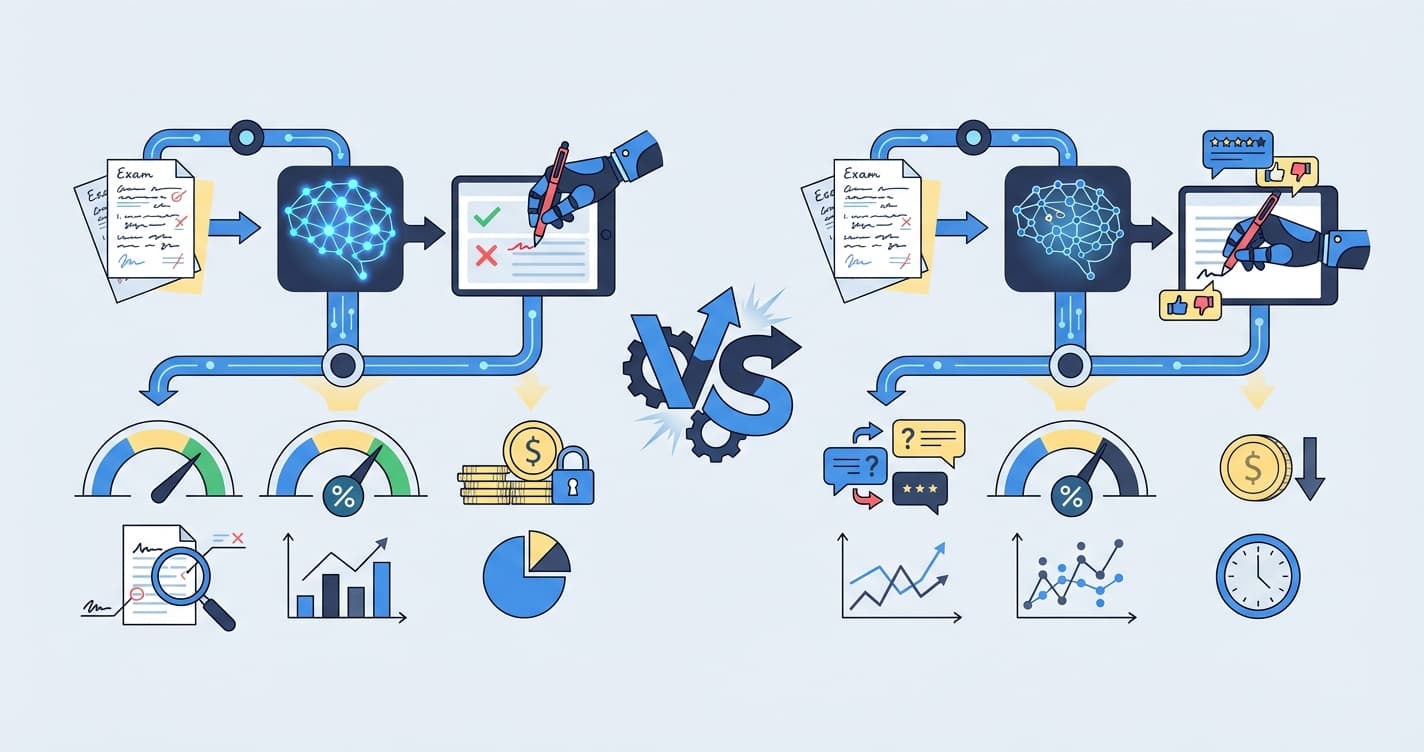
Because teams search for GradeLab alternative for AI handwritten grading, this comparison stays practical. It looks at grading accuracy, teacher review, student feedback, and whether the workflow helps written work improve.
TL;DR
GradeLab is a globally-positioned AI grading platform: strong handwriting recognition, multilingual support (30+ languages), 99%+ stated accuracy, on-premise deployment available. Built for institutions including governments and large EdTech players.
IntelGrader is an AI grading platform built around the remediation loop — score, diagnose the concept gap, recommend the next lesson, track mastery over time. Built specifically for tutoring centres, coaching centres, and K-12 educators who need to teach better from what their students wrote.
Both grade handwritten work. The category divergence is what happens after the score.
Overview
If you are choosing between GradeLab and IntelGrader, you have already narrowed your search to AI tools that handle handwritten student work — a small, focused category. Both grade papers fast. Both use OCR and AI to read handwriting. The difference is downstream.
GradeLab is a global AI grading platform. It marks handwritten exams, essays, and structured assignments across 30+ languages including Arabic and Chinese, and claims 99%+ handwriting accuracy. The platform serves a broad mix of schools, universities, coaching centres, EdTech platforms, corporate training arms, and government education initiatives. Trusted logos include the Government of Abu Dhabi, NVIDIA Inception, Microsoft for Startups, and AWS. GradeLab's bet is breadth: any institution, any language, any subject, fast and accurate marking.
IntelGrader is an AI grading and analytics platform built for a narrower buyer: tutoring centres, coaching centres, and K-12 educators who want the next teaching action surfaced automatically from each batch's data. IntelGrader handles handwritten English and Hindi work with step-credit on maths and rubric-aligned essay scoring, then layers on concept-level diagnostics, per-student remediation paths, batch-level "what to re-teach next" recommendations, and mastery tracking over time.
Both platforms are right for their target buyer. The question is which one matches your actual workflow.
The category positioning, made explicit
| GradeLab | IntelGrader | |
|---|---|---|
| Score student work fast | ✅ Industry-leading accuracy | ✅ Within ±5% of human markers |
| Multilingual breadth (30+ languages) | ✅ | ❌ English + Hindi focus |
| Concept-level diagnostics per student | ❌ Score + feedback | ✅ Sub-concept tagging |
| Per-student remediation paths | ❌ | ✅ Auto-generated next-step actions |
| Batch-level "what to teach next" | ❌ | ✅ Cohort gap detection |
| Government / enterprise deployment | ✅ Abu Dhabi, EdTech platforms | ❌ SMB-to-mid-market tutoring |
| On-premise option | ✅ Available | ❌ SaaS only |
| Curriculum alignment | Generic rubric engine | CBSE, ICSE, GCSE, NESA, NCERT chapter mapping |
Where GradeLab is genuinely better
A few categories where GradeLab is clearly the right choice:
- Government and enterprise institutions — Abu Dhabi government and the global EdTech logos signal serious investment in institutional procurement readiness
- Multilingual marking — 30+ language support is far ahead of IntelGrader's current English + Hindi scope; non-Indian/non-English markets benefit
- On-premise / air-gapped deployment — high-stakes contexts (national exams, defense training, regulated industries) often require on-premise
- Generic multi-subject marking at scale — if you need to mark welding-certification papers in Arabic, GradeLab is built for that; IntelGrader is not
For these use cases, GradeLab is the better tool.
Where IntelGrader leads
The use cases where IntelGrader is the right pick:
- Tutoring centres marking weekly batches and wanting the lesson-plan layer auto-generated — GradeLab marks; IntelGrader marks and tells you what to teach next
- Coaching centres running NEET / JEE / Board prep that map student errors to NCERT chapters — IntelGrader's domain mapping is built specifically for this
- Centres that care about concept-level patterns across a cohort — "47% of batch missed VSEPR theory — re-teach next session" is the IntelGrader output, not the GradeLab one
- Tutors who want a system that closes the loop from grading back into next week's teaching plan — this is the IntelGrader product premise
The trade-off, made explicit
Choosing between these tools is a trade between two things:
GradeLab gives you:
- Higher headline accuracy (99% vs ~94% on hard cases)
- Broader language and subject support
- Enterprise-grade deployment options
- Institutional trust signals
IntelGrader gives you:
- A concept-tagged diagnosis of every student's gaps
- An auto-generated remediation path for each student
- A one-page "next session focus" recommendation per batch
- Mastery tracking that surfaces plateaus and prerequisite gaps over time
If your buying motion is "we need accurate, fast marking and we'll handle the analysis ourselves," GradeLab wins. If your buying motion is "we want the system to do the analysis and give us the teaching action plan," IntelGrader wins.
A concrete example
Picture a 30-student JEE Maths batch sitting their weekly mock test on Sunday.
With GradeLab: Marks delivered by Monday morning. Tutor sees scores: highest 92%, lowest 31%, batch average 64%. Tutor opens 30 papers to understand where the gaps are. By Tuesday afternoon, tutor has drafted next session's plan based on memory + intuition + scanning the lowest-scoring students' papers. Time spent: ~4 hours.
With IntelGrader: Marks delivered by Sunday evening. Monday morning report says: "Top 3 missed concepts batch-wide — angular momentum conservation (61% miss), rotational kinematics (47%), torque on extended bodies (43%). Recommended Tuesday session: 30 min angular momentum re-teach with hands-on demo + worked examples; 15 min on torque problems; individual remediation paths sent to bottom 8 students." Tutor reviews and tweaks in 20 minutes. Time spent: ~20 minutes.
Both centres get marked papers. One also gets the next session's lesson plan.
Pricing comparison
Both vendors quote per institution, but rough benchmarks for 2026:
- GradeLab — quote-based; institutional pricing starts in the four-figures-USD-per-month range for mid-size coaching centres; on-premise deployment adds licence costs
- IntelGrader — flat-rate per centre; ₹8,000–20,000/month (~US$100–250) for mid-size centres; SaaS only
These aren't directly comparable since the products do partially-different things, but for the AI grading layer alone IntelGrader is the lighter-weight option.
Decision framework
| Your situation | Pick |
|---|---|
| Government, defense, or regulated-industry institution | GradeLab (on-premise + enterprise procurement) |
| Marking non-English/non-Hindi work | GradeLab (multilingual breadth) |
| Tutoring centre wanting next-week lesson plans auto-generated | IntelGrader |
| Coaching centre on NEET / JEE / Board prep with NCERT chapter analytics | IntelGrader |
| Mid-size centre wanting flat-rate SaaS without procurement overhead | IntelGrader |
| Multi-national education group needing on-premise + 30 languages | GradeLab |
FAQ
Is IntelGrader more accurate than GradeLab?
No — GradeLab claims industry-leading accuracy at 99%+. IntelGrader's accuracy is typically within ±5% of human markers, which is competitive but not a category leader. IntelGrader's edge is the analytics and remediation layer that GradeLab does not provide, not raw marking accuracy.
Can GradeLab generate per-student remediation paths?
GradeLab focuses on marking, feedback, and analytics on the grading itself. It does not produce per-student next-step lesson recommendations or batch-level "what to teach next" outputs. That diagnostic + remediation layer is what IntelGrader is built around.
Does IntelGrader support non-English languages?
Currently English and Hindi handwriting are supported at production quality. If you need Arabic, Chinese, or other languages for handwriting recognition, GradeLab is the better choice.
Which is cheaper?
For mid-size tutoring or coaching centres, IntelGrader's flat-rate per-centre pricing typically lands well below GradeLab's institutional quote. But the two products are not feature-equivalent — you are buying different things, and the cheaper option isn't automatically the right one.
Can I use both?
Yes — but uncommon. The two platforms overlap on marking, so running both is mostly redundant. Most centres pick one for the grading workflow. The exception is large multi-language institutions that use GradeLab for institutional marking and IntelGrader for specific Indian-curriculum tutoring batches.
Where to go from here
If you have multilingual, enterprise, or on-premise requirements, talk to GradeLab. If you are a tutoring or coaching centre that wants the diagnostic and remediation layer that turns marked work into next-week's lesson plan, book an IntelGrader demo and we'll walk through what your students' data actually says.
Related IntelGrader resources
- Gradescope alternative for AI grading
- AI grading for handwritten math
- AI grading platform checklist
- handwritten answer grading software
Related IntelGrader resources
Ready to see the difference?
Book a demo and see how IntelGrader's AI grading compares in action.