AI Grading and Smart Grading Guide

What Is Smart Grading?
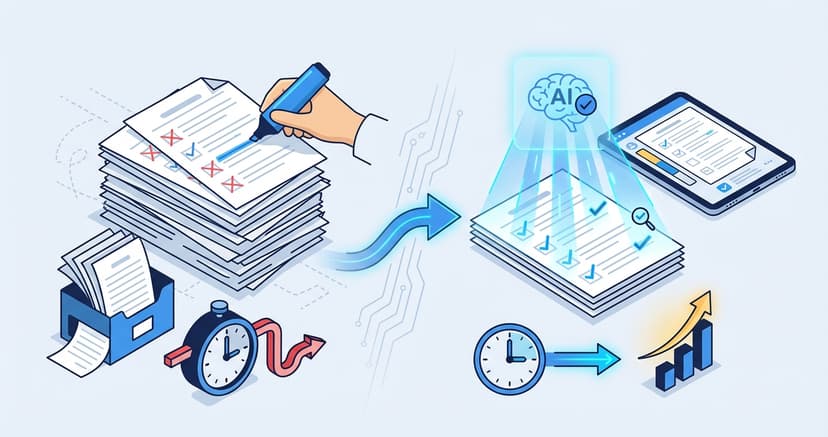
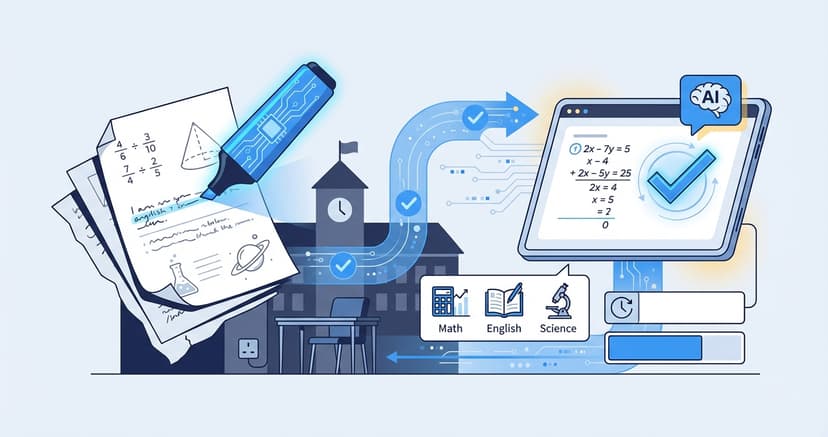
Smart grading is the use of artificial intelligence to mark student work automatically, delivering scores and personalised feedback without a human marker. Instead of a tutor spending three to five minutes per worksheet with a red pen and mark scheme, smart grading software reads the student's answers — including handwritten ones — compares them against the correct solutions, and returns results in seconds.
The term covers a range of AI-powered assessment technologies, from simple multiple-choice auto-scoring to advanced systems that use optical character recognition (OCR) to interpret handwritten mathematical notation, evaluate working-out steps, and generate targeted feedback on where a student went wrong. At its most capable, smart grading does not just tell a student their score. It tells them why they lost marks and what to review next.
Smart grading is not a replacement for teachers or tutors. It is a replacement for the most repetitive, time-consuming part of their job: the marking pile. The tutor's expertise — explaining concepts, building confidence, adapting lessons in real time — remains irreplaceable. What smart grading eliminates is the hours of mechanical correction that prevent tutors from doing more of that high-value work.
The technology has matured rapidly since 2026. Advances in machine learning, natural language processing, and computer vision have brought smart grading from a research concept to a practical, commercially available tool used by tutoring centres, coaching institutes, and schools worldwide. Platforms like IntelGrader, Gradescope, and others now offer AI-powered grading at varying levels of automation, accuracy, and specialisation.
If you have ever wondered whether there is a faster, fairer, more consistent way to mark student work, smart grading is the answer — and it is already changing how education businesses operate.
How Does Smart Grading Work?
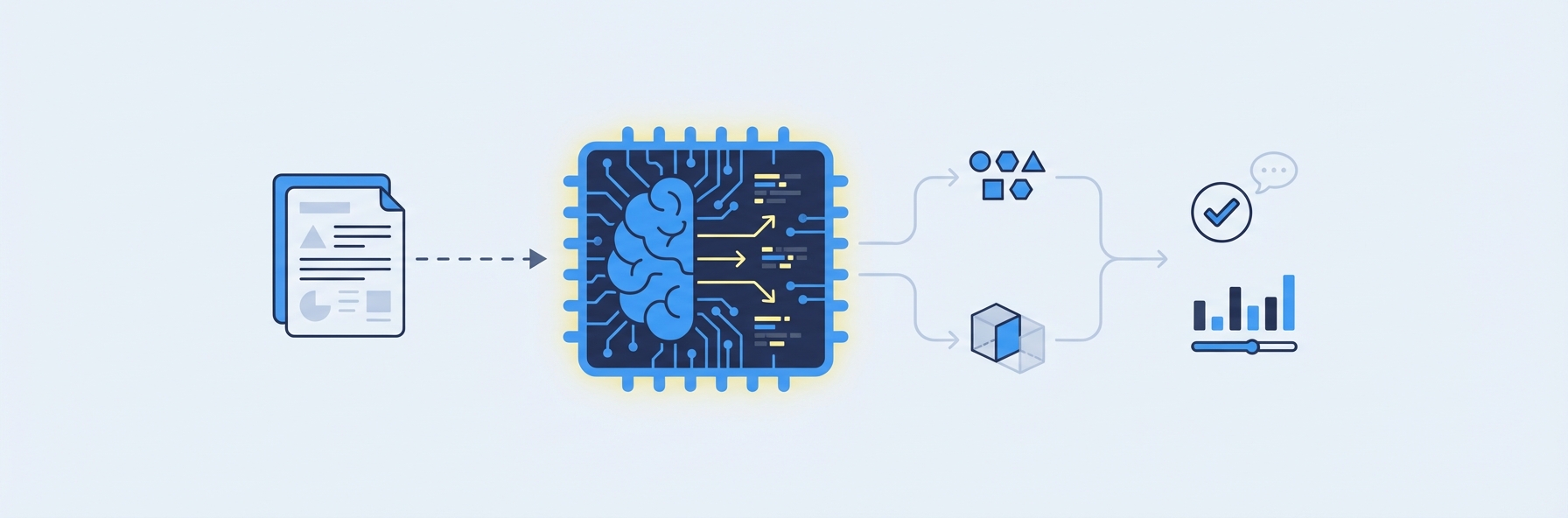
Smart grading systems vary in their technical approach, but the core workflow follows three steps. Understanding this process helps demystify what the AI is actually doing and why the results are reliable.
Step 1: Upload the worksheet and answer key
The educator uploads a worksheet — the set of questions students will answer — along with the correct answers and any marking criteria. This might be a PDF of a printed worksheet, a set of questions exported from a textbook publisher, or a custom resource the centre has created. The answer key tells the AI what a correct response looks like for each question, including accepted alternative methods or partial-credit rules.
This step happens once per worksheet. After the initial upload, the same resource can be assigned to any number of students across any number of sessions without reconfiguration.
Step 2: Students complete their work and submit
Students complete the worksheet exactly as they normally would — on paper, with a pen or pencil. There is no app for the student to install, no device required, and no change to the way they work. This is a deliberate design choice in the best smart grading systems: the student's experience should mirror real exam conditions as closely as possible.
Once the student finishes, a tutor or centre administrator captures the completed work. Depending on the platform, this might involve photographing the paper with a smartphone, feeding it through a scanner, or uploading a digital file. The captured image is then submitted to the AI for grading.
Step 3: AI reads, evaluates, and grades
This is where the technology takes over. The smart grading system uses optical character recognition to read the student's handwriting, parsing digits, mathematical symbols, words, and working-out steps from the captured image. The AI then compares each answer against the answer key, applying the marking criteria to determine whether the response is correct, partially correct, or incorrect.
Within seconds, the system returns a fully graded worksheet. Each question is scored, and the student receives feedback explaining what they got right and where they went wrong. The results are logged automatically, feeding into progress tracking dashboards that tutors and parents can access over time.
The entire cycle — from photograph to graded result — typically takes under thirty seconds. For context, a human marker would spend three to five minutes on the same worksheet, and the feedback they provide is often limited to ticks, crosses, and a score at the top of the page.
The technology behind it
Modern smart grading relies on several interconnected technologies:
- Optical character recognition (OCR) converts handwritten or printed text into machine-readable data. For mathematics, this is particularly challenging because the AI must interpret digits, operators, fractions, exponents, and spatial relationships between symbols.
- Machine learning models trained on thousands of real student responses learn to recognise patterns in correct and incorrect answers, including common misconceptions and alternative valid methods.
- Natural language processing (NLP) enables the system to generate meaningful, human-readable feedback rather than simply returning a numerical score.
The combination of these technologies is what distinguishes smart grading from earlier approaches like optical mark recognition (OMR), which could only read bubbled-in answers on standardised answer sheets. Smart grading handles free-form responses — the kind of work students actually produce in classrooms and tutoring sessions.
Benefits of Smart Grading

The advantages of smart grading extend far beyond saving time, though the time savings alone are substantial enough to justify adoption for most education businesses. Here is what smart grading delivers in practice.
Dramatic time savings. A tutoring centre processing 200 worksheets per week can reclaim 10 to 15 hours of marking time. Those hours go back to tutors for lesson planning, one-to-one support, and professional development — or simply for a healthier work-life balance. At scale, this is the difference between a sustainable operation and one where staff burn out.
Consistent, unbiased marking. Every worksheet is assessed against the same criteria, every time. There is no variation between markers, no drift in standards over the course of a long grading session, and no unconscious bias towards neat handwriting or presentation. Research from the Education Endowment Foundation (EEF) consistently identifies the quality and consistency of feedback as one of the strongest levers for improving pupil attainment — with high-quality feedback adding up to eight months of additional progress over a year.
Instant feedback. Students learn best when feedback is immediate. John Hattie's synthesis of over 1,800 meta-analyses in Visible Learning ranks feedback among the top influences on student achievement, but only when it is timely and specific. A correction received thirty seconds after finishing a worksheet is far more valuable than one returned days later, by which point the student has moved on and forgotten the context. Smart grading closes the feedback loop in real time.
Actionable analytics and progress tracking. Every graded worksheet becomes a data point. Over time, patterns emerge: which topics a student consistently struggles with, which types of errors recur, and where intervention is needed. Tutors can use this data to personalise their teaching. Parents can see clear, evidence-based progress reports rather than vague reassurances. This data-driven approach aligns with the Department for Education's emphasis on using assessment to inform personalised learning.
Scalability without proportional cost. In a traditional marking model, more students means more marking hours, which means higher costs or longer working days. Smart grading breaks that equation. The marginal cost of grading one additional worksheet is effectively zero, which means a centre can grow its student base without proportionally increasing its marking burden. This is particularly important for tutoring businesses in growth mode.
Reduced tutor workload and improved retention. Tutor burnout is a real and growing problem in the supplementary education sector. A significant contributor is the volume of after-hours marking that tutors are expected to complete, often unpaid or underpaid. By automating the most tedious part of the role, smart grading makes the job more sustainable and more attractive — improving both staff satisfaction and retention.
Standardised quality across multiple markers. Centres with multiple tutors often struggle with inter-marker variability: two tutors marking the same paper may arrive at different scores. Smart grading eliminates this problem entirely. Every paper is marked by the same system using the same rules, which means a student's score reflects their knowledge, not which tutor happened to mark their work.
Smart Grading vs Traditional Marking
The differences between smart grading and traditional manual marking are significant across every dimension that matters to education providers. Here is a direct comparison.
| Dimension | Traditional Marking | Smart Grading |
|---|---|---|
| Speed | 3-5 minutes per worksheet | Under 30 seconds per worksheet |
| Consistency | Varies by marker, fatigue, and time of day | Identical criteria applied every time |
| Feedback turnaround | Hours to days after submission | Instant — results returned in seconds |
| Feedback depth | Depends on individual marker's effort and time | Structured, specific, and actionable by default |
| Progress tracking | Manual spreadsheet entry, if done at all | Automatic, with dashboards and trend analysis |
| Scalability | Linear — more papers equals more hours | Near-zero marginal effort per additional paper |
| Bias | Subject to unconscious marker preferences | Objective, criteria-based assessment |
| Cost at scale | Tutor time at market rates per hour | Fraction of manual cost as volume increases |
Traditional marking is not without its strengths. A skilled human marker can interpret ambiguous responses with nuance, provide encouragement tailored to a student's personality, and catch creative approaches to a problem that fall outside a standard rubric. The strongest approach for many centres is a hybrid model: let the AI handle the bulk grading and free up human markers to review flagged responses and provide the personal touch where it matters most.
For a deeper analysis of how the two approaches compare across different subjects and use cases, read our dedicated guide on smart grading vs traditional marking.
Who Uses Smart Grading?

Smart grading is not a niche technology limited to well-funded institutions. It is designed to be practical and accessible for the full range of education providers — from individual tutors working from home to large coaching chains operating across multiple cities.
Tutoring centres
High-street and community tutoring centres are the primary adopters of smart grading. These businesses typically serve between 50 and 500 students per week, with maths as the dominant subject. The marking burden scales directly with student numbers, making AI grading the single most impactful operational improvement a centre can make. Whether the centre follows a franchise model or operates independently, smart grading fits into existing processes with minimal disruption.
For UK-based centres, IntelGrader offers a platform purpose-built for this exact workflow. Learn more about smart grading for UK tutoring centres.
Schools and academies
Schools face the same marking pressures as tutoring centres, often at greater scale. A secondary school maths department might have six teachers, each setting and marking homework for 150 students. That is 900 worksheets per homework cycle. Smart grading does not replace the teacher's professional judgement on complex questions, but it can handle the routine marking that consumes evenings and weekends — freeing teachers to focus on planning, differentiation, and the kind of responsive teaching that OFSTED's framework rewards.
Coaching institutes and test prep centres
In markets where competitive examination preparation is the norm — India, South Korea, parts of the Middle East, and increasingly the UK — coaching institutes face marking challenges at an entirely different scale. A single institute preparing students for board exams or entrance tests can generate thousands of worksheets per day. At that volume, manual marking is not just inefficient; it is physically impossible without a large team of dedicated markers. Smart grading is the only viable approach for organisations operating at this level.
Private tutors
Individual tutors working one-to-one or with small groups gain the most from smart grading not in raw time savings (the absolute hours are smaller) but in the quality of the service they can offer. Parents paying premium rates for private tutoring expect detailed, data-backed updates on their child's progress. Smart grading platforms generate this data automatically, turning what was once an awkward end-of-term conversation into a clear, evidence-based progress review. That transparency builds trust and reduces churn.
Online and hybrid education providers
The shift towards online and hybrid tutoring since 2026 has created new demand for digital grading workflows. Students working remotely can photograph their handwritten work at home and submit it digitally. Smart grading processes these submissions exactly as it would in-centre work, making it an essential component of any tutoring operation that serves students both in person and remotely.
Smart Grading Tools in 2026
The market for AI-powered grading tools has expanded rapidly, with platforms now available for different audiences, subjects, and price points. Here is a brief overview of the landscape.
IntelGrader is built specifically for tutoring centres, coaching institutes, and K-12 educators. Its core strength is AI grading for handwritten maths: advanced OCR reads student handwriting, grades responses against an answer key, and delivers instant feedback and progress tracking. It is designed for the daily scan-and-grade workflow of education businesses, with no institutional license required and minimal setup time.
Gradescope (owned by Turnitin) targets the higher education market. It supports multi-subject grading — maths, code, essays, science — and integrates deeply with learning management systems like Canvas and Blackboard. Gradescope uses AI-assisted answer grouping where instructors review clustered responses, rather than fully automated grading. It requires an institutional license and is priced for universities. For a detailed comparison, see IntelGrader vs Gradescope.
Other tools in the space include Crowdmark (collaborative online grading for universities), Codio (automated grading for computer science), and various LMS-native quiz engines that handle multiple-choice auto-scoring. Each serves a different slice of the market.
The key question when evaluating smart grading tools is not which platform is best in the abstract, but which one is best for your specific situation — your subjects, your student volume, your workflow, and your budget.
For a comprehensive comparison of the leading platforms, features, and pricing, read our roundup of the best smart grading tools in 2026.
Getting Started with Smart Grading
Adopting smart grading does not require a technology overhaul. The process is straightforward, and most education providers are up and running within a day.
1. Identify your biggest marking bottleneck
Start by asking where your team spends the most time marking. For most tutoring centres and schools, the answer is maths — especially worksheets involving handwritten working. That is the workload where smart grading delivers the most immediate return.
2. Choose the right tool for your context
Match the platform to your needs. If you are a tutoring centre or coaching institute grading handwritten maths worksheets daily, a specialist tool like IntelGrader is designed for exactly that workflow. If you are a university department grading multi-subject exams with a team of teaching assistants, a platform like Gradescope may be a better fit. The right tool is the one that matches your subjects, your scale, and your budget.
3. Upload your existing resources
You do not need to create new materials. Upload the worksheets you already use — PDFs, scanned images, or exported files from your worksheet library. Add the answer keys. The platform stores everything in a reusable library that your team can access at any time.
4. Run a pilot
Start with a single class, subject, or tutor. Grade a week's worth of worksheets using the AI and compare the results against what a human marker would have produced. This gives you confidence in the accuracy and lets your team build familiarity with the workflow before rolling out more broadly.
5. Scale and measure
Once the pilot confirms that the grading quality meets your standards, expand to additional classes, subjects, and centres. Track the metrics that matter: hours saved on marking, feedback turnaround time, and — over the medium term — student progress data. These numbers become the business case for continued investment.
Ready to see smart grading in action? Book a free demo of IntelGrader and grade your first stack of handwritten worksheets in minutes.
To understand how AI is reshaping the broader tutoring landscape, read our analysis of how AI is transforming UK tutoring.
Frequently Asked Questions
Does smart grading work for handwritten maths?
Yes, and handwritten maths is where modern smart grading technology has advanced the most. Platforms like IntelGrader use OCR engines specifically trained on handwritten mathematical notation — digits, algebraic expressions, fractions, equations, and working-out steps. The system handles the full range of handwriting quality that real students produce, from neat and careful to hurried and messy. This is a critical capability because maths, unlike multiple-choice subjects, requires the AI to interpret spatial relationships between symbols, not just recognise individual characters.
How accurate is AI grading compared to human markers?
AI grading accuracy on well-defined question types — arithmetic, algebra, equation solving — is comparable to that of experienced human markers. In practice, the agreement rate between AI and human graders often meets or exceeds the inter-marker reliability typically observed between two human markers assessing the same paper. Where the AI encounters an ambiguous response or unusual method, the best systems flag it for human review rather than guessing. This means the automated results are trustworthy, with a human safety net for edge cases. Accuracy continues to improve with each generation of machine learning models.
Is smart grading suitable for exam preparation?
Smart grading is particularly well suited to exam preparation because it replicates exam-like conditions. Students complete work on paper by hand, the same way they will in the actual exam. The AI grades against mark schemes that can be aligned to exam board criteria (AQA, Edexcel, OCR, and others for UK qualifications). For tutoring centres and coaching institutes running test prep programmes, the combination of high-volume practice with instant, criteria-aligned feedback is exactly what students need to improve efficiently. The EEF's research emphasises that regular low-stakes testing with feedback is one of the most effective revision strategies.
What subjects can smart grading handle?
The range of subjects depends on the platform. IntelGrader currently specialises in mathematics — from primary arithmetic through to A-level calculus — because maths generates the highest marking volume and is the most technically demanding subject for handwriting recognition. Other platforms cover broader subject ranges: Gradescope supports code, essays, and science alongside maths, while various LMS-native tools handle multiple-choice and short-answer questions across all subjects. The field is evolving rapidly, and subject coverage is expanding with each year.
Do students need a device or app to use smart grading?
No. In the best smart grading systems, students complete their work on paper with a pen or pencil, exactly as they would in a normal lesson or examination. There is no student-facing app, no login required, and no additional screen time. The only technology involved is a smartphone or scanner used by the tutor or administrator to capture the completed worksheet. This is a deliberate design choice: for handwritten practice to serve as effective exam preparation, the conditions should mirror the exam as closely as possible.
How much does smart grading cost?
Pricing varies significantly across platforms. University-oriented tools like Gradescope typically require institutional licenses negotiated through Turnitin, priced per student per year. Tutoring-focused platforms like IntelGrader offer more accessible pricing structures designed for smaller operations — no institutional contract required. For most tutoring centres, even a modest reduction in marking hours covers the cost of the platform several times over. The most practical way to evaluate cost is to book a demo and discuss pricing based on your specific student volume and workflow.
Ready to transform your grading?
See how IntelGrader can save your tutoring centre 10+ hours per week with AI-powered grading.