AI in Indian Education: How Technology Is Transforming Coaching and Schools
AI in Indian Education: Transforming How Students Learn
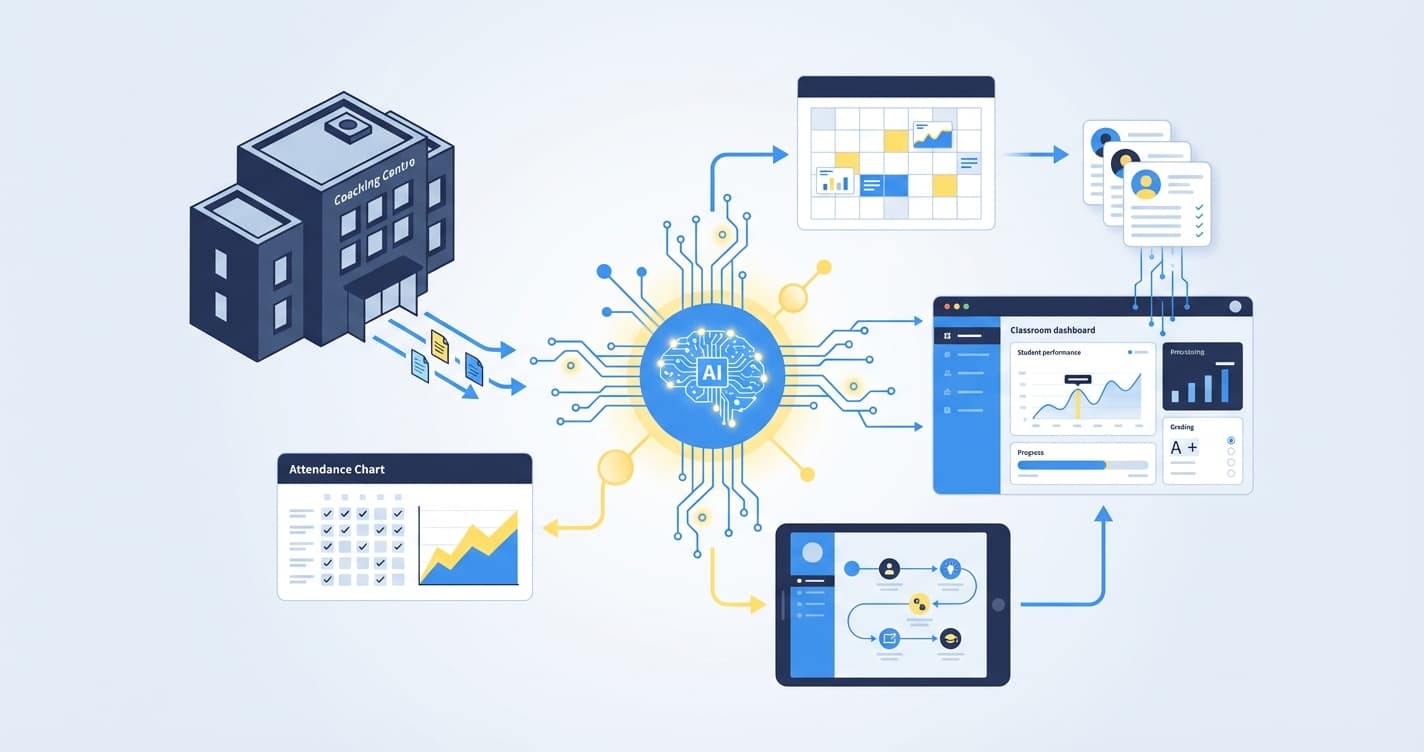
Artificial intelligence in Indian education refers to the application of machine learning, natural language processing, computer vision, and other AI technologies to improve how students learn, how teachers teach, and how educational institutions operate across India's vast and diverse education system. From AI-powered grading of handwritten maths papers to adaptive learning platforms that personalise content for each student, AI Indian education applications are moving from experimental pilots to mainstream adoption.
India's education system serves over 26 crore students across 15 lakh schools, 70,000+ coaching centres, and thousands of colleges and universities. The scale is unlike any other country. And the challenges — teacher shortages, inconsistent assessment quality, language diversity, infrastructure gaps, and the pressure of high-stakes competitive examinations — are uniquely Indian. AI is not a silver bullet for these challenges, but it is becoming an increasingly powerful tool that is already changing outcomes for millions of students.
The State of Indian Education: By the Numbers
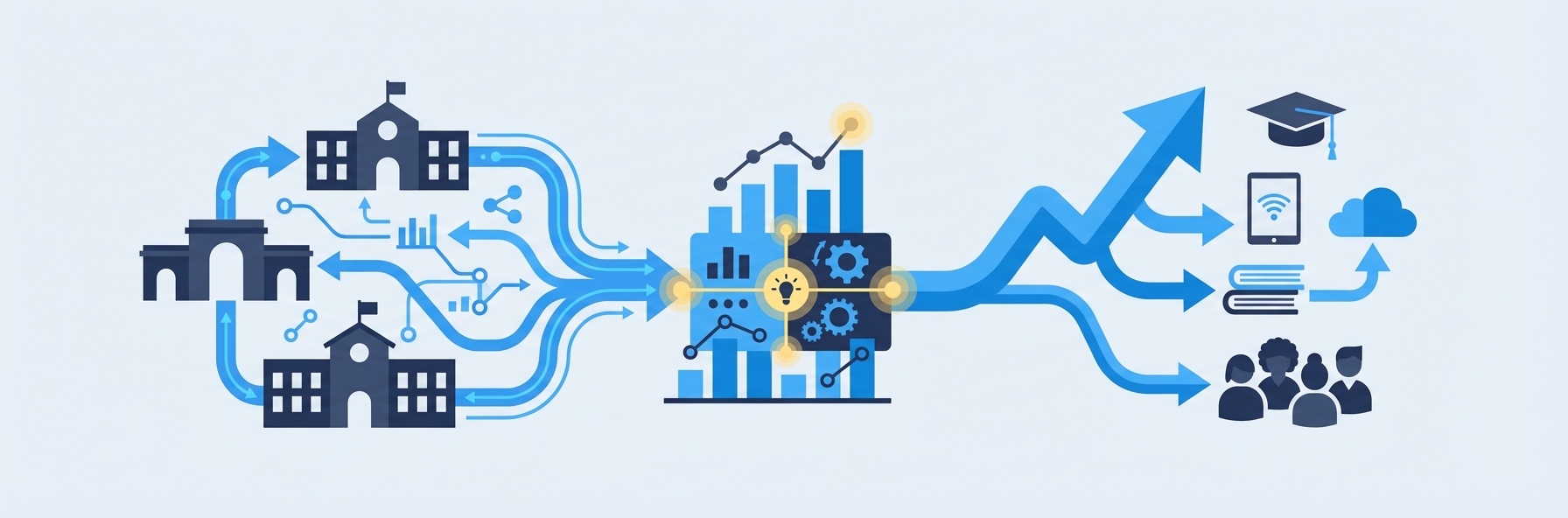
To understand why AI matters for Indian education, you need to understand the scale and complexity of the system it aims to improve.
Scale That Defies Simple Solutions
- 26.5 crore students enrolled across primary, secondary, and higher education (UDISE+ 2023-24)
- 15 lakh schools — from single-teacher schools in rural Rajasthan to elite institutions in metro cities
- 70,000+ coaching centres serving an estimated 7 crore students in private tuition and test preparation
- 96 lakh teachers across government and private schools, with a persistent shortage in STEM subjects
- 50+ education boards — CBSE, ICSE, and 37 State Boards, each with different curricula and examination patterns
- 22 official languages plus English, creating a multilingual education landscape that no other country faces at this scale
The Assessment Crisis
The most immediate pressure point in Indian education is assessment. India's examination culture — board exams at Class 10 and Class 12, competitive exams like JEE and NEET, state-level entrance tests — places enormous weight on test performance. Yet the assessment system is struggling:
- Teacher workload: A government school teacher handling 5 sections of 40 students each generates 200 papers per test. At 10 minutes per paper, that is 33 hours of correction — for a single test, in a single subject.
- Feedback delays: Students in coaching centres typically wait 3-7 days for test results. In school settings, the delay can stretch to 2-3 weeks. By the time feedback arrives, students have moved to new chapters.
- Inconsistency: Studies by CBSE have shown that the same answer sheet, marked by different examiners, can receive scores differing by 10-15%. This inconsistency affects lakhs of students in board examinations.
- Lack of diagnostic feedback: Most students receive a score — a number at the top of their paper. Very few receive detailed feedback on which concepts they misunderstand, which steps they got wrong, or what they should revise.
The Digital Divide Is Narrowing
India's digital infrastructure has transformed in the past five years:
- 80+ crore internet users as of 2026, up from 56 crore in 2026
- Smartphone penetration has reached 75% of households, including Tier-2 and Tier-3 cities
- UPI and digital payments have normalised technology use among populations that were previously offline
- JioSpark and affordable data have made high-speed internet accessible even in smaller towns
This digital infrastructure is the foundation that makes AI Indian education applications viable at scale. You cannot deploy AI-powered grading if students do not have smartphones to photograph their answer sheets. You cannot deliver adaptive learning if learners cannot get online. India's digital transformation has removed these barriers for the majority of the student population.
NEP 2020 and the Technology Mandate
The National Education Policy 2020 is the most significant education reform document India has produced in three decades. Its implications for technology adoption — and specifically AI — are profound.
What NEP 2020 Says About Technology
NEP 2020 dedicates an entire chapter to technology in education and makes several explicit recommendations:
- Technology-enabled assessment: The policy calls for moving away from rote-based, high-stakes examinations toward continuous, competency-based assessment. It specifically envisions "AI-based software" that can help test higher-order skills.
- Adaptive learning: NEP recommends personalised learning pathways that adjust to each student's pace and level — a function that is only practically achievable at scale through AI.
- Teacher empowerment: The policy emphasises that technology should "aid the teacher" rather than replace them. AI tools that handle repetitive tasks (like grading) while freeing teachers for higher-value work align directly with this vision.
- Data-driven governance: NEP calls for a National Educational Technology Forum (NETF) and envisions data infrastructure that enables evidence-based decision-making at every level of the education system.
The NDEAR Framework
The National Digital Education Architecture (NDEAR), launched as part of NEP implementation, provides a technical framework for interoperability between education platforms. This means that AI tools built for Indian education can potentially integrate with government systems, school management platforms, and other tools through standardised data formats and APIs.
State-Level Implementation
Individual states are moving at different speeds, but the direction is consistent:
- Karnataka has piloted AI-powered adaptive learning in government schools through partnerships with edtech companies.
- Andhra Pradesh has implemented personalised learning programs using AI across thousands of government schools.
- Kerala has been a pioneer in digital education, with KITE (Kerala Infrastructure and Technology for Education) deploying technology across all government schools.
- Rajasthan and Madhya Pradesh are experimenting with AI-based diagnostic assessments to identify learning gaps among students.
The policy environment in India is not just neutral toward AI in education — it is actively encouraging it. Coaching centres and schools that adopt AI tools are aligning with the national direction, not swimming against the current.
AI Applications in Indian Education
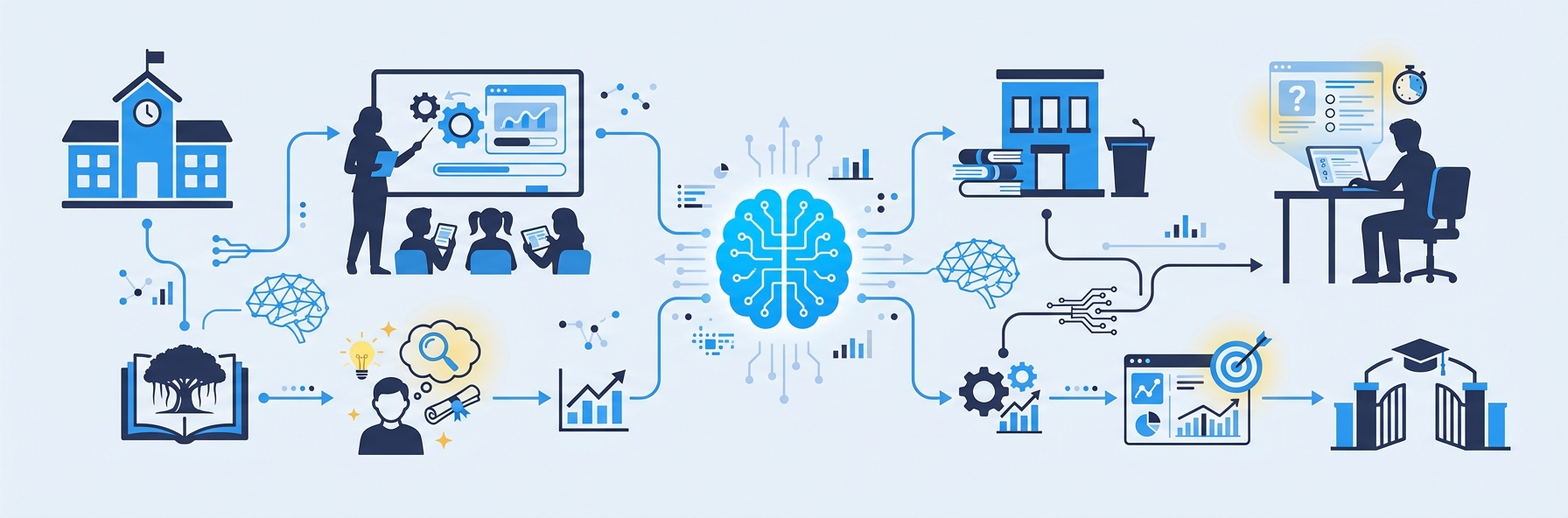
AI is being applied across multiple dimensions of education. Here are the applications that are most relevant and most mature for the Indian context.
1. Automated Grading of Handwritten Work
The problem: Indian exams require handwritten answers. Grading handwritten maths, science, and essay-type answers is enormously time-consuming — and it is the single largest consumer of teacher time in coaching centres and schools.
The AI solution: Advanced optical character recognition (OCR) combined with machine learning reads handwritten student papers, evaluates answers against marking schemes, assigns step-by-step marks, and generates detailed feedback. Platforms like IntelGrader have built OCR engines specifically trained on handwritten mathematical notation, capable of reading the varied handwriting styles that Indian students produce.
Impact in India: A coaching centre with 300 students can save 15-20 faculty hours per week by automating maths grading alone. Students receive instant feedback instead of waiting days. Marking consistency improves dramatically — the AI applies the same rubric to every paper, every time.
Current maturity: Production-ready for maths and science subjects with well-defined marking schemes. Improving for subjective and essay-type answers.
Learn more about AI grading for coaching centres
2. Adaptive Learning Platforms
The problem: In a class of 50 students, each student has a different level of understanding, different strengths, and different gaps. A teacher delivering a single lesson to the entire class inevitably moves too fast for some students and too slow for others.
The AI solution: Adaptive learning platforms use AI to assess each student's current level and dynamically adjust the content, difficulty, and pace of instruction. Students who have mastered a concept move ahead. Students who are struggling receive additional explanation and practice on the specific sub-topics they find difficult.
Impact in India: Particularly powerful for competitive exam preparation (JEE, NEET), where the syllabus is vast and each student's preparation level varies significantly. Adaptive learning ensures that each student's limited study time is spent on the areas that will improve their score the most.
Current maturity: Several Indian platforms offer adaptive learning, though the depth of personalisation varies significantly. The best systems combine AI-driven content recommendation with human tutor oversight.
3. Personalised Feedback Generation
The problem: When a student gets a question wrong, knowing the correct answer is not enough. The student needs to understand why their approach was wrong, which concept they misunderstood, and what they should study to correct the gap.
The AI solution: AI systems analyse student errors and generate personalised feedback that goes beyond "incorrect." For a maths problem, the feedback might say: "You correctly identified this as a quadratic equation and applied the formula, but made a sign error when calculating the discriminant. Review the section on discriminant calculation in Chapter 4."
Impact in India: This level of detailed feedback is something most Indian students never receive. In a coaching centre with 50 students per batch, the faculty member does not have time to write personalised comments on every answer for every student. AI can deliver this feedback at scale, instantly.
Current maturity: Available for maths and structured subjects. IntelGrader provides step-level feedback on handwritten maths answers. Language and essay feedback is improving but not yet at the same level.
4. Predictive Analytics for Student Performance
The problem: Identifying students who are falling behind often happens too late — after a poor board exam result or a failed entrance test. By then, the opportunity for intervention has passed.
The AI solution: Predictive analytics uses historical performance data to identify students who are at risk of underperformance. By tracking patterns across multiple assessments — declining scores, persistent weaknesses in specific topics, inconsistent performance — the AI can flag students who need additional support before they fall too far behind.
Impact in India: For JEE and NEET coaching centres, where the stakes are extraordinarily high, early identification of struggling students can change outcomes. A student flagged in October can receive targeted intervention. A student flagged after the March exam cannot.
Current maturity: Available as part of assessment platforms that track longitudinal student data. Requires multiple data points (regular assessments) to generate meaningful predictions.
5. Administrative Automation
The problem: Running a coaching centre involves significant administrative overhead: fee collection, attendance tracking, batch scheduling, parent communication, and regulatory compliance.
The AI solution: AI-powered management systems automate routine administrative tasks. Smart scheduling optimises batch allocation based on student levels and faculty availability. Automated fee reminders reduce collection delays. Chatbots handle routine parent queries.
Impact in India: Administrative automation frees coaching centre owners and managers to focus on educational quality rather than operational firefighting. For centres handling 500+ students across multiple batches, the time savings are significant.
Current maturity: Well-established. Multiple Indian platforms (Teachmint, Classplus, Vidyalaya) offer administrative automation with varying levels of AI sophistication.
How Indian Coaching Centres Are Embracing AI
Coaching centres are the frontline of AI adoption in Indian education. Unlike government schools (where procurement cycles are slow) or universities (where bureaucratic inertia is significant), private coaching centres can adopt new technology quickly — and the competitive pressure to do so is intense.
Kota: The Coaching Capital Experiments
Kota, Rajasthan — India's coaching capital for JEE and NEET preparation — is a bellwether for technology adoption in Indian coaching. With over 200 coaching centres and an estimated 2.5 lakh students, Kota's institutes generate millions of handwritten answer sheets annually. The correction burden is immense, and the first centres to adopt AI grading have gained a measurable advantage in feedback speed and consistency.
Large Kota institutes are using AI tools to:
- Grade weekly practice tests within hours instead of days
- Identify topic-level weaknesses across thousands of students simultaneously
- Generate personalised revision plans for each student based on their error patterns
- Provide parents (often based in other cities) with regular, data-backed progress updates via WhatsApp
Metro City Coaching Chains
Coaching chains in Delhi, Mumbai, Bangalore, Hyderabad, and Pune are adopting AI across multiple operational areas:
- Assessment automation using AI grading platforms
- Content personalisation using adaptive learning tools
- Operational efficiency using coaching management software with AI features
- Marketing and student acquisition using AI-powered analytics to identify high-value channels
Tier-2 and Tier-3 City Adoption
The most encouraging trend in AI Indian education is adoption beyond metro cities. Coaching centres in cities like Lucknow, Jaipur, Indore, Bhopal, Nagpur, and Coimbatore are increasingly adopting AI tools. The combination of affordable smartphones, reliable internet, and cloud-based SaaS pricing (no large upfront investment) has made AI accessible to centres that could never have afforded enterprise software a decade ago.
Individual Tutors and Small Centres
Even individual maths tutors running home-based tuition classes are beginning to use AI grading. The economics are compelling: a tutor handling 30 students who spends 5 hours per week on correction can reclaim that time for additional batches (more revenue) or personal time (better quality of life). The barrier to entry is a smartphone and a subscription — no hardware, no IT staff, no complex implementation.
Government Initiatives Supporting AI in Education
The Indian government is actively investing in AI for education through multiple channels:
National AI Strategy (NITI Aayog)
NITI Aayog's National Strategy for Artificial Intelligence identified education as one of five priority sectors for AI deployment. The strategy envisions AI-powered tools for personalised learning, automated assessment, and administrative efficiency across India's education system.
PM eVIDYA and DIKSHA
The DIKSHA (Digital Infrastructure for Knowledge Sharing) platform, developed by the Ministry of Education, provides a national platform for digital educational content. The platform is increasingly incorporating AI features, including adaptive content delivery and learning analytics. PM eVIDYA expanded digital education access during the pandemic and continues to serve as infrastructure for AI-powered educational tools.
ATAL Innovation Mission
Through Atal Tinkering Labs and the Atal Innovation Mission, the government has established AI and technology exposure programs in thousands of schools. While these focus on AI literacy rather than AI-powered education tools, they are building the awareness and comfort with AI technology that will drive adoption.
State Education Technology Agencies
Several states have established dedicated agencies for education technology:
- KITE (Kerala): A global exemplar in public school technology deployment
- Samagra Shiksha Technology Division: Implementing technology-enabled learning across states
- State-level edtech partnerships: States like Andhra Pradesh and Karnataka have partnered with AI companies to pilot AI-powered learning in government schools
Research and Academic Institutions
India's IITs, IISc, and other premier institutions are conducting significant research in AI for education:
- IIT Bombay's work on handwriting recognition for Indian languages
- IISc Bangalore's research on adaptive learning algorithms
- IIT Delhi's work on natural language processing for Indian languages
- IIIT Hyderabad's contributions to speech recognition and language technology
Challenges: What Stands Between AI and Indian Students
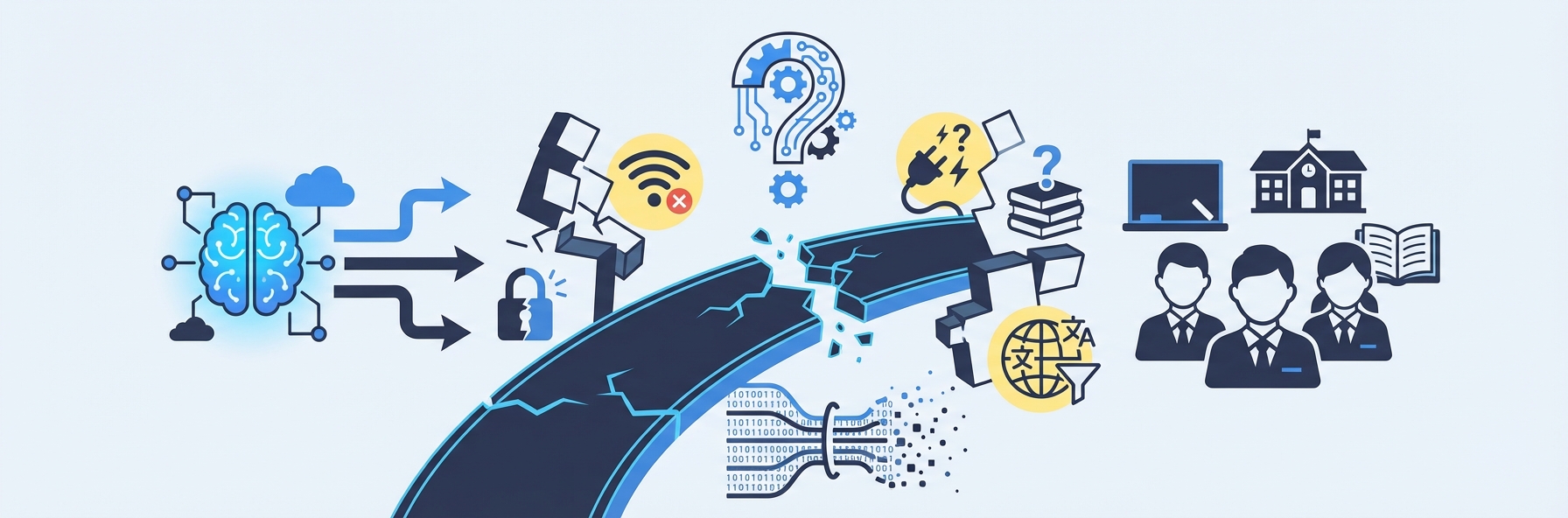
While the potential is enormous, significant challenges remain in scaling AI Indian education solutions across the country.
Infrastructure Gaps
Despite rapid improvement, India's digital infrastructure remains uneven:
- Rural connectivity: While urban India has near-universal internet access, rural areas still face connectivity gaps. Approximately 35% of rural India lacks reliable internet access.
- Power supply: Intermittent electricity in many parts of India affects the usability of digital tools. Cloud-based AI solutions are only useful when students and teachers can get online.
- Device access: While smartphone penetration is high, many low-income families share a single device among multiple family members. Dedicated access for educational use is not guaranteed.
Language Diversity
India's linguistic diversity is both a strength and a challenge for AI:
- 22 scheduled languages plus hundreds of dialects mean that AI tools must support multilingual content
- Code-switching is common — students and teachers seamlessly mix English with Hindi or regional languages, which confuses AI systems trained on single-language datasets
- Script diversity: Devanagari, Tamil, Telugu, Kannada, Malayalam, Bengali, and Gujarati scripts each require separate OCR training
- Mathematical notation: While mathematical symbols are largely universal, the way Indian students write numbers, annotate their work, and structure their solutions has regional patterns that AI must learn
Affordability and Access
Despite India's price-sensitive market:
- Per-student budgets in Indian coaching centres are significantly lower than in Western markets. AI tools must be priced for Indian economics — ₹ per student, not $ per student.
- Freemium models are essential for adoption. Teachers and centres need to experience the value before committing budget.
- Government school budgets are constrained. AI deployment in public education requires either government funding or extremely low-cost delivery models.
Teacher Readiness
Technology adoption ultimately depends on teachers:
- Digital literacy varies enormously across India's 96 lakh teachers. Urban, younger teachers are generally comfortable with technology. Rural teachers with decades of experience may resist.
- Fear of replacement is a real concern. Teachers need to understand that AI handles grading, not teaching. The human relationship — explaining, motivating, adapting to student emotions — remains irreplaceable.
- Training infrastructure for AI tools in education is underdeveloped. Most teachers learn from colleagues or YouTube tutorials rather than structured professional development programs.
Data Privacy and Ethics
As AI systems collect student data, privacy concerns are legitimate:
- Student performance data is sensitive. Parents want to know how it is stored, who can access it, and whether it could affect their child's future opportunities.
- Algorithmic bias is a concern. AI systems trained on data from urban, English-medium schools may not perform equitably for students from different backgrounds.
- India's Digital Personal Data Protection Act 2023 establishes a legal framework for data protection, and AI education tools must comply with these requirements, particularly regarding minors' data.
Quality and Accuracy Concerns
AI tools are not perfect:
- Handwriting recognition accuracy, while high (95%+), is not 100%. Students with unusual handwriting, physical disabilities, or who write in non-standard layouts may experience errors.
- Step-by-step evaluation of mathematical working is more complex than simple answer checking. Marking partial credit correctly requires sophisticated understanding of mathematical reasoning.
- Subject limitations: AI grading is most reliable for subjects with well-defined correct answers (maths, science). Evaluating creative writing, critical thinking, or subjective analysis remains a challenge.
The Future of AI in Indian Education: 2026-2030
The trajectory of AI Indian education is accelerating. Here is what the next five years are likely to bring:
Near-Term (2026-2027)
- AI grading becomes mainstream in urban coaching centres. Centres that adopt it gain a measurable competitive advantage in student outcomes and operational efficiency.
- Voice-based AI tutoring in Indian languages emerges as a practical reality, enabling personalised tutoring for students who are more comfortable speaking than typing.
- WhatsApp-based AI interactions become common — students send a photograph of a problem they are stuck on and receive step-by-step guidance.
- Government school pilots expand from a few hundred to thousands of schools, with state governments investing in AI-powered assessment for continuous evaluation under NEP 2020.
Medium-Term (2027-2029)
- Multilingual AI matures, with reliable support for maths and science content in Hindi, Tamil, Telugu, Bengali, and other major Indian languages.
- AI-powered career guidance uses student performance data, aptitude analysis, and market trends to recommend career paths — particularly valuable in India where high-stakes exam results narrow options early.
- Coaching centre consolidation accelerates. Centres with AI-driven operational efficiency and student outcomes gain market share. Those relying entirely on manual processes face increasing competitive pressure.
- Integration with board exam systems: CBSE and ICSE begin experimenting with AI-assisted evaluation for internal assessments, laying groundwork for potential use in board examinations.
Longer-Term (2029-2030)
- Personalised learning paths become the norm rather than the exception. Each student's experience is uniquely tailored to their learning style, pace, and goals.
- AI teaching assistants work alongside human teachers, handling routine explanations and practice while the teacher focuses on complex doubt-clearing and student motivation.
- Universal access through government partnerships makes AI-powered education tools available to every Indian student, regardless of economic background.
- National assessment data infrastructure enables evidence-based education policy decisions, fulfilling NEP 2026's vision for data-driven governance in education.
What This Means for Coaching Centres Today
The coaching centres that thrive in the coming years will be those that adopt AI strategically — not as a gimmick, but as a fundamental operational improvement. The starting point for most centres is the assessment bottleneck.
If your maths faculty is spending 20 hours per week correcting papers, that is 20 hours not spent on teaching, mentoring, and improving student outcomes. AI-powered grading eliminates that bottleneck instantly. Students receive better feedback. Parents receive structured progress reports. Teachers reclaim their time for high-value work.
The technology is ready. The policy environment is supportive. The competitive pressure is real. The question is not whether AI will transform Indian education — it is whether your coaching centre will be an early adopter or a late follower.
See how IntelGrader's AI grading works for Indian coaching centres | Book a free demo
Related reading:
- AI-Powered Tuition Management for Coaching Centres
- Best Tutoring Management Software in 2026
- How to Automate Grading in Coaching Centres
- IntelGrader vs Teachmint
FAQ
How is AI currently being used in Indian coaching centres?
The most common AI application in Indian coaching centres today is automated grading of handwritten maths and science worksheets. Platforms like IntelGrader use OCR and machine learning to read student answer sheets, evaluate step-by-step working, assign marks, and generate personalised feedback — all in seconds. Beyond grading, coaching centres are using AI for adaptive test generation (selecting questions based on student ability), predictive analytics (identifying students at risk of underperformance), and administrative automation (fee reminders, attendance tracking, scheduling optimisation). Adoption is highest in JEE and NEET preparation centres in cities like Kota, Delhi, Hyderabad, and Bangalore, but is spreading rapidly to Tier-2 and Tier-3 cities.
Is AI in education supported by the Indian government?
Yes, extensively. The National Education Policy (NEP) 2026 explicitly calls for technology-enabled assessment, adaptive learning, and AI-based tools in education. NITI Aayog's National Strategy for Artificial Intelligence identifies education as a priority sector. Government platforms like DIKSHA provide digital infrastructure that AI tools can build on. Multiple state governments (Karnataka, Andhra Pradesh, Kerala, Rajasthan) have piloted AI-powered learning in government schools. The policy environment in India is actively supportive of AI in education, creating opportunities for both government schools and private coaching centres to adopt AI tools with confidence.
Will AI replace teachers in Indian coaching centres?
No. AI replaces the most repetitive, time-consuming part of a teacher's job — grading and correction — not the teaching itself. The human elements of education — explaining concepts clearly, motivating students, adapting to individual learning styles, building confidence, handling emotional and social aspects of student development — are irreplaceable by AI. NEP 2020 explicitly states that technology should "aid the teacher" rather than replace them. In practice, coaching centres that adopt AI grading find that their teachers become more effective, not less relevant. Faculty freed from 20 hours of weekly correction spend that time on doubt sessions, personalised mentoring, and curriculum improvement.
What are the biggest challenges for AI adoption in Indian education?
The primary challenges are infrastructure gaps (unreliable internet in rural areas), language diversity (AI tools must support multiple Indian languages and scripts), affordability (pricing must work for Indian economics), teacher readiness (varying levels of digital literacy), and data privacy concerns (particularly regarding minors' data under India's Digital Personal Data Protection Act 2023). Among these, affordability and teacher readiness are being addressed fastest — cloud-based SaaS pricing has made AI tools accessible to mid-sized coaching centres, and the new generation of teachers is increasingly comfortable with technology. Infrastructure gaps remain the most significant barrier, particularly for rural and government school adoption.
How can a coaching centre start using AI without a large budget?
Start with a single, high-impact application: AI-powered grading for your largest maths batch. Platforms like IntelGrader require no hardware investment — students photograph answer sheets with existing smartphones, and the AI handles grading in the cloud. The cost savings from reduced correction time (faculty hours reclaimed) typically exceed the software cost from the first month. Use WhatsApp to share AI-generated progress reports with parents — this improves satisfaction at zero additional cost. As you see results, expand to additional batches and subjects. The key is starting small, proving value, and growing from there rather than attempting a centre-wide transformation overnight.
Sources
- Ministry of Education, Government of India. National Education Policy 2026. https://www.education.gov.in/sites/upload_files/mhrd/files/NEP_Final_English.pdf
- Ministry of Education. UDISE+ Report 2023-24. Unified District Information System for Education, providing comprehensive data on Indian schools, teachers, and student enrolment. https://udiseplus.gov.in
- NITI Aayog. National Strategy for Artificial Intelligence #AIforAll. India's national AI strategy identifying education as a priority sector. https://niti.gov.in/national-strategy-artificial-intelligence
- KPMG and Google. Online Education in India: 2026. Market sizing and analysis of India's private coaching and tuition industry.
- Ministry of Electronics and Information Technology. Digital Personal Data Protection Act 2023. Legal framework governing data privacy in India, with specific provisions for children's data. https://www.meity.gov.in
Ready to transform your grading?
See how IntelGrader can save your tutoring centre 10+ hours per week with AI-powered grading.