
AI Grading for Handwritten Math: How OCR, Step-Credit, and Concept Tagging Work
Are your instructors drowning in a sea of handwritten math assignments, spending countless hours meticulously grading each problem? The manual grading process is not only time-consuming and prone to human error but also delays crucial feedback to students. Imagine a world where ai grading handwritten math isn't a futuristic concept but a powerful reality, instantly providing accurate feedback and freeing up your educators to focus on what they do best: teaching. IntelGrader is here to make that vision a reality for tutoring and coaching centers across the US.
The Grading Burden in Tutoring Centers: A Time Sink
Tutoring and coaching centers play a pivotal role in supplementing traditional education, helping students master complex subjects like math, prepare for high-stakes exams such as the SAT and AP exams, and achieve academic success. However, the very act of assessing student progress—especially in math, where handwritten solutions are the norm—often becomes a significant bottleneck.
Consider the typical scenario:
- Hours Lost to Manual Grading: Tutors spend an average of 5-10 hours per week, per subject, on grading alone. For centers with multiple instructors and hundreds of students, this quickly escalates to hundreds of hours monthly. This time could be better spent on lesson planning, student engagement, or professional development.
- Delayed Feedback, Stalled Learning: The longer it takes to grade assignments, the longer students wait for feedback. This delay can hinder their learning trajectory, as misconceptions might persist, and opportunities for timely intervention are missed. Studies show that immediate feedback can improve learning outcomes by up to 15%.
- Inconsistency and Subjectivity: Manual grading, even by experienced educators, can suffer from inconsistencies. Different instructors might grade the same error with varying degrees of leniency, leading to an unfair and less standardized assessment experience for students. This can be particularly problematic when trying to align with Common Core standards or state curriculum guidelines.
- Administrative Overload: Beyond the grading itself, there's the administrative burden of tracking scores, identifying common errors, and communicating progress to parents. This manual data entry is ripe for errors and further consumes valuable staff time.
These challenges directly impact a center's operational efficiency, instructor satisfaction, and ultimately, student success. The need for a more streamlined, accurate, and timely grading solution is undeniable.
How AI Grading Transforms Handwritten Math Assessment
AI grading handwritten math is a game-changer, leveraging advanced technologies to interpret and evaluate student work with unprecedented speed and accuracy. At its core, this technology combines sophisticated Optical Character Recognition (OCR) with Natural Language Processing (NLP) specifically designed for mathematical expressions.
Here’s how IntelGrader brings this technology to life for your center:
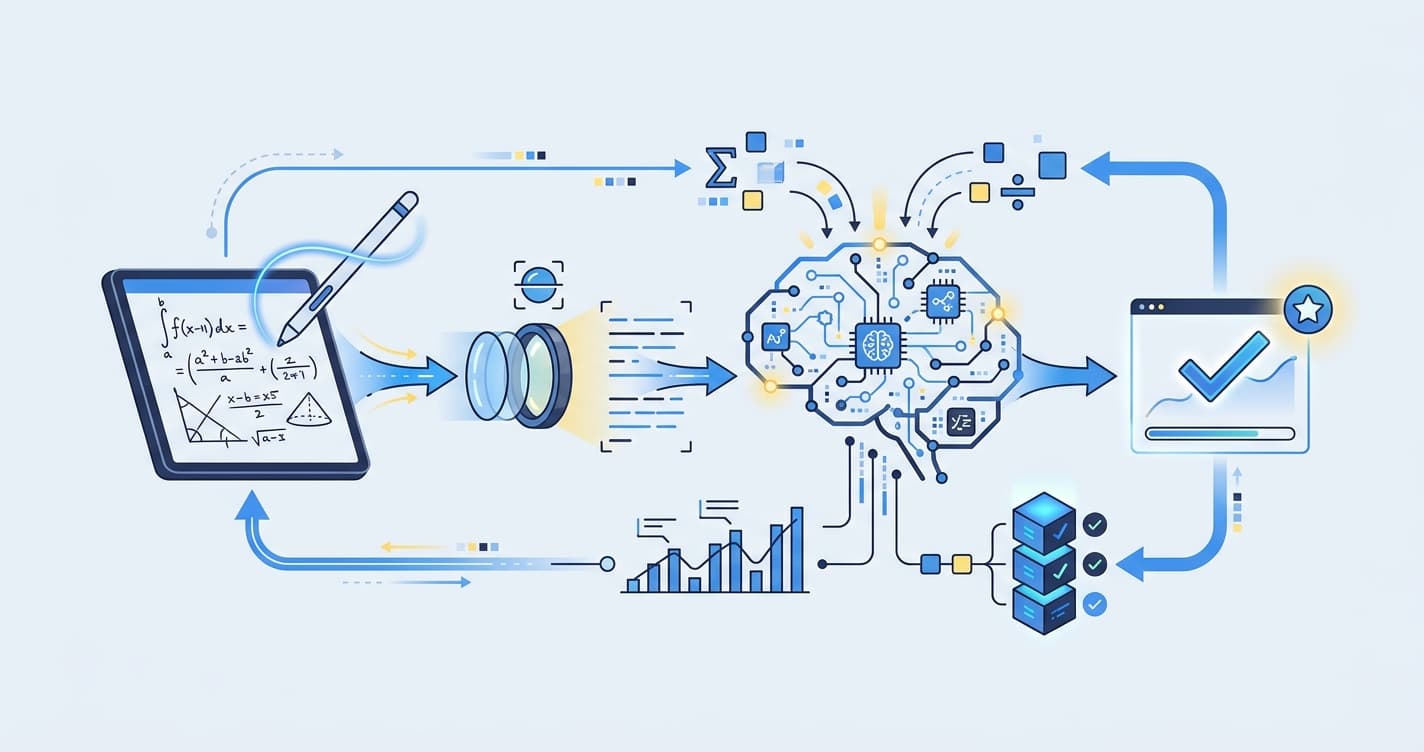
- Scanning and Digitization: Students submit their handwritten math assignments, either by uploading scanned images or taking photos with a smartphone. IntelGrader’s intelligent system processes these images.
- Advanced Handwriting Recognition: Our proprietary OCR engine, fine-tuned for mathematical notation, accurately recognizes handwritten numbers, symbols, equations, and even complex diagrams. It understands the context of mathematical expressions, not just individual characters.
- Step-by-Step Solution Analysis: Unlike basic grading tools that only check the final answer, IntelGrader analyzes each step of a student's solution. It can identify where an error occurred in the problem-solving process, whether it was a conceptual misunderstanding, a calculation error, or a procedural mistake.
- Concept-Level Mapping: IntelGrader goes beyond simply marking answers right or wrong. It maps student performance to specific mathematical concepts and sub-concepts (e.g., "algebraic manipulation," "fraction operations," "geometric proofs"). This provides a much deeper understanding of a student's strengths and weaknesses, crucial for personalized learning paths.
- Instant, Detailed Feedback: Within moments of submission, students receive comprehensive feedback, including correct answers, identification of errors, and often, hints or explanations for correction. This immediate feedback loop is vital for effective learning, allowing students to address misconceptions while the material is still fresh in their minds.
With IntelGrader, you can grade 50 handwritten math papers in just 30 minutes, achieving 95%+ accuracy. This drastically reduces the grading workload, freeing up instructors to focus on high-value teaching activities.
Ready to save hours on grading? Book a free demo
Beyond Just Answers: Deep Learning with AI-Powered Grading
Traditional grading often stops at the final answer, or perhaps identifies a misstep without explaining why it's an issue. IntelGrader's AI-powered grading pushes past this limitation, offering a level of diagnostic insight that was previously unattainable without extensive manual effort. This is where the true power of ai grading handwritten math shines, transforming assessment into a powerful learning tool.
IntelGrader's differentiators include:
- Formula-Level Error Analysis: Our AI doesn't just flag an incorrect step; it understands the underlying mathematical principles. For example, if a student incorrectly applies the distributive property, the system can pinpoint that specific conceptual error, rather than just marking the line as wrong. This deep analysis helps tutors understand the root cause of student struggles.
- Concept-Level Mapping for Targeted Intervention: By linking errors to specific concepts (e.g., "failure to isolate variables," "incorrect application of Pythagorean theorem"), IntelGrader generates a personalized concept mastery profile for each student. This data is invaluable for tutors, enabling them to tailor their instruction precisely to a student's learning gaps, ensuring alignment with Common Core standards and preparing students effectively for state-specific assessments.
- Learning Trajectory Creation: Based on the concept mastery data, IntelGrader can suggest personalized learning paths and recommend practice problems or modules to reinforce weak areas. This proactive approach ensures students are continuously progressing and building a solid foundation, crucial for success in subjects tested by the SAT, ACT, and AP exams.
- Adaptive Assessment: As students improve, the AI can adapt future assessments, offering more challenging problems in areas where mastery is demonstrated, and more supportive practice where needed. This dynamic approach keeps students engaged and optimizes their learning experience.
This sophisticated level of analysis empowers educators to move beyond reactive grading to proactive, data-driven instruction. It ensures that every student receives targeted support, maximizing their potential and making every tutoring session more effective.
Ready to elevate your center's efficiency and student outcomes? Request a personalized quote
Unlocking Institutional Insights and Student Growth
For tutoring centers, especially those operating across multiple branches or managing large cohorts of students, gaining a holistic view of performance is critical. IntelGrader doesn't just streamline individual student assessments; it aggregates data to provide powerful institutional analytics, driving smarter educational strategies and proving program effectiveness.
Here's how IntelGrader delivers these insights:
- Multi-Batch and Multi-Center Analytics: Our platform allows administrators to track performance across different batches, courses, and even multiple center locations. You can compare student progress, identify top-performing instructors, and pinpoint specific curriculum areas that might need adjustment across your entire organization. This is invaluable for maintaining consistent quality and scaling operations.
- Identifying Common Learning Gaps: By analyzing aggregated data from hundreds or thousands of submissions, IntelGrader can identify common misconceptions or difficult concepts across a student population. If a significant percentage of students are struggling with a particular type of problem, it signals an opportunity for curriculum review or enhanced instructional strategies.
- Evidence-Based Assessment and Reporting: In an educational landscape increasingly focused on accountability, particularly with requirements like ESSA (Every Student Succeeds Act) for evidence-based assessment, IntelGrader provides robust data. Our platform generates detailed reports on student progress, concept mastery, and intervention effectiveness, offering concrete evidence of your center's impact. These reports are excellent for communicating value to parents and stakeholders.
- Predictive Analytics for Student Success: Over time, the data collected by IntelGrader can be used to identify students at risk of falling behind or predict future performance on standardized tests. This allows centers to implement early interventions, ensuring no student is left behind and maximizing their chances of success on exams like the SAT, ACT, and AP exams.
- Demonstrating Value and ROI: With clear, quantifiable data on student improvement and time saved, tutoring centers can powerfully demonstrate their value proposition to prospective clients. This data-driven approach enhances credibility, justifies pricing, and ultimately contributes to the center's growth and profitability.
By transforming raw assessment data into actionable insights, IntelGrader empowers tutoring centers to optimize their educational programs, ensure accountability, and foster a culture of continuous improvement.
Implementing AI Grading: A Seamless Transition for Your Center
Adopting new technology can sometimes feel daunting, but IntelGrader is designed for a seamless integration into your existing workflows, ensuring minimal disruption and maximum benefit. Our focus is on making the transition to ai grading handwritten math as smooth as possible for busy educators and administrators.
Here’s what makes implementation with IntelGrader straightforward:
- User-Friendly Interface: The platform is intuitively designed for both instructors and students. Instructors can easily upload assignments, review graded papers, and access analytics. Students find it simple to submit their work and understand the feedback provided.
- Flexible Submission Options: Students can submit their handwritten work in various ways: by taking a photo with their smartphone, scanning a document, or even uploading a PDF. This flexibility ensures accessibility for all students and streamlines the submission process.
- Minimal Training Required: While comprehensive support and training resources are available, the platform's ease of use means your team can quickly get up to speed. Most instructors can begin using IntelGrader effectively after a short introductory session.
- Scalable Solution: Whether you're a small local tutoring center or a large organization with multiple branches, IntelGrader scales with your needs. Our infrastructure is built to handle high volumes of submissions and data, ensuring consistent performance as your center grows.
- Dedicated Support: Our team provides ongoing support, from initial setup and onboarding to continuous technical assistance. We are committed to ensuring your center fully leverages the power of AI grading.
- Security and Privacy: We understand the importance of student data security and privacy. IntelGrader is built with robust security measures and adheres to data protection best practices, giving you peace of mind.
Integrating IntelGrader means your center can immediately start reaping the benefits: saving 10+ hours per week per instructor, delivering faster and more consistent feedback, and gaining deeper insights into student learning. This translates directly into improved student outcomes, increased instructor satisfaction, and enhanced operational efficiency for your entire organization.
Frequently Asked Questions (FAQ)
How accurate is IntelGrader's AI for handwritten math?
IntelGrader achieves over 95% accuracy in grading handwritten math assignments, comparable to or exceeding human graders in consistency. Our advanced OCR and mathematical NLP engines are specifically trained on diverse handwritten datasets to ensure robust performance across various handwriting styles and problem types.
Can IntelGrader grade step-by-step solutions or just final answers?
Yes, IntelGrader is designed to analyze step-by-step solutions. It doesn't just check the final answer but evaluates each logical step, identifying specific errors in calculations, formula application, or conceptual understanding. This provides much richer diagnostic feedback than simple answer checking.
Is IntelGrader compatible with different math curricula, like Common Core or specific state standards?
Absolutely. IntelGrader's concept-level mapping and flexible problem setup allow centers to align grading with any curriculum, including Common Core, SAT/AP prep materials, and specific state standards. You can tag problems and concepts to your curriculum framework, making it easy to track mastery against your specific learning objectives.
How long does it take to get feedback after a student submits an assignment?
Feedback is nearly instantaneous. Once a student submits their handwritten assignment (via photo or scan), IntelGrader processes and grades it within seconds to a few minutes, depending on the complexity and length of the assignment. This rapid turnaround ensures students receive timely feedback vital for effective learning.
What kind of insights can tutoring centers gain from IntelGrader's analytics?
Tutoring centers can gain a wealth of insights, including individual student concept mastery profiles, common error patterns across cohorts, performance comparisons between different batches or instructors, and overall program effectiveness. These analytics help centers identify curriculum gaps, personalize instruction, and demonstrate student progress with concrete data.
Start Grading Smarter Today
Stop letting manual grading consume valuable time and resources. IntelGrader helps tutoring centers save 10+ hours per week with AI-powered grading for handwritten math, delivering instant, accurate feedback and deep learning insights. Empower your instructors, accelerate student progress, and optimize your center's operations with the future of assessment.
Ready to transform your grading?
See how IntelGrader can save your tutoring centre 10+ hours per week with AI-powered grading.